

Past the screamer goals, the world-class skill, the tactical masterclasses and human togetherness, what’s the real appeal of the World Cup if not a chance to witness referees show their stuff on the biggest stage?
This World Cup has undoubtedly delivered. For years, fans will remember exactly where they were when England defeated Mexico in the Round of 16, or when Cape Verde gutted out a draw against Spain.
But unfortunately, another lasting memory of this stellar tournament might just be the lack of consistent decision-making from its officials — from the Folarin Balogun situation to Argentina’s questionable comeback against Egypt.
Fans were given another helping of controversial refereeing on Saturday, muddying what was otherwise an electric day of quarterfinal action, as VAR pleaded the fifth to gift England a goal, then worked overtime to doom Switzerland.
The way the four semifinalists booked their tickets to the final four might come into question, but their rankings speak for themselves. This is the first time since FIFA rankings were introduced in 1992 that the top four teams in the world qualify for the World Cup semifinals. At the end of the day, quality does win out.
Here are the big takeaways from the final day of the quarterfinals.
England finds a way, but not one Tuchel wanted
It doesn’t matter how you win, as long as you win. Right?
For the fourth straight major international tournament — and for the first time under Thomas Tuchel — England is through to the final four after an ugly, get-it-done win against veritable dark horse Norway. But for Tuchel, a win like that is nowhere near enough.
“We made life very, very difficult for ourselves today. The result is fantastic, we’re in the last four, it’s amazing. But I’m not happy with the performance,” Tuchel said in the mixed zone after the 2-1 win. “Again, the commitment is there, but we made life very, very difficult for us. The way we played, how we played, sloppy, lots of technical mistakes. Not fast enough… We were lucky today.”
Tuchel’s grand team-building experiment has worked so far. The reason England has been able to adapt, whether facing a Siege of Malta-esque onslaught from Mexico or needing a late offensive push, has been because of how Tuchel put this team together. The stars played like stars, the role players bought into the system, and Tuchel pressed all the right buttons with his tactics and substitutes.
All those factors came into play again against Norway: Jude Bellingham proved a difference-maker, scoring a second straight brace and joining Diego Maradona as the only players to do so in consecutive knockout-round games, subs Dan Burn and Djed Spence proved impactful defensively as England retained its lead, and Bukayo Saka looked like a game-changer on the wing.
Despite the pieces fitting into place, despite the result and a second straight World Cup semifinal, despite quieting the behemoth Erling Haaland, Tuchel was left dissatisfied. Much to the chagrin of his locker room.
“Maybe he doesn’t know what it’s like to play in those kinds of conditions against Erling Haaland, (Martin) Odegaard, (Antonio) Nusa, (Alexander) Sorloth. That’s not an easy team to play against,” Bellingham said when asked about his coach’s post-game comments. “So, I think we’ve tried to create a positive environment. We should continue that going into the final four. I can’t speak highly enough of the lads. You’re not gonna win every game popping the ball and making a thousand passes. Sometimes you have to win dirty and we did that again tonight.”
The hardest tests are on the horizon for this English team, and given the result, it’s a concerning time for cracks to be showing.
Switzerland’s hopes take a dive
Confident it could go toe-to-toe with anyone after gutting out a penalty shootout win against Colombia in the Round of 16, Switzerland looked unfazed by the Argentinian test ahead.
Even down 1-0 after the 10th minute, the Swiss held their own, winning the possession battle in the first half 57-43 and playing 127 passes in the opposing half to only 52 from Argentina.
It was always going to be an uphill battle, but is there a population better at climbing than the Swiss?
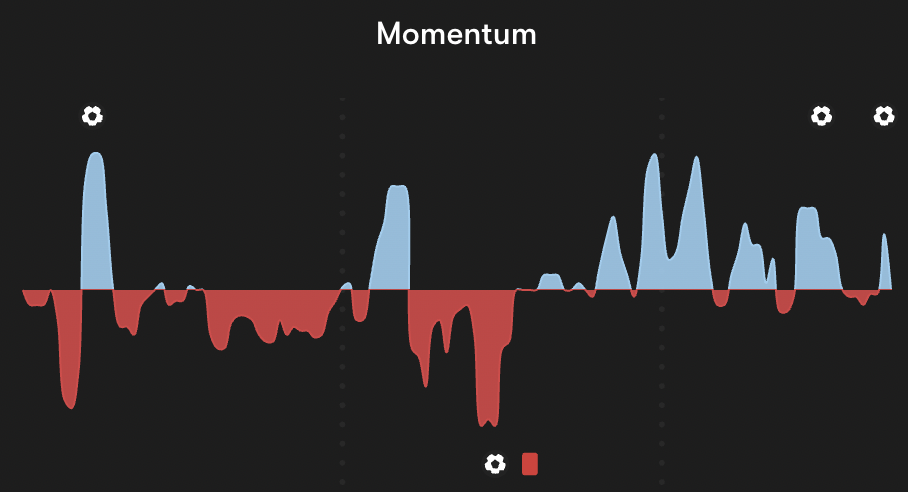
On the equalizer in the 67th minute, the momentum was in Switzerland’s hands and had been for the previous 12 minutes, pressuring an unconvincing Argentinian defence before finally breaking through courtesy of Dan Ndoye.
But just as quickly as it came, it all fell apart.
Only minutes later, Switzerland’s chance at a major upset took a dive, as Breel Embolo was called for a second yellow card for simulation after a bizarre VAR sequence.
Originally, Argentina’s Leandro Paredes was handed a yellow for what appeared to be a tackle on Embolo. However, the play was reviewed as a result of a ‘Mistaken Identity’ call, a new rule implemented at this World Cup that allows the video assistant referee to reverse a booking made by the on-field official, specifically as it concerns bookings for the incorrect player. The rule deems that, because Paredes was booked on the play, the booking had to be transferred to Embolo.
After a review, it was deemed that Embolo took a dive — undoubtedly true, as he was never touched on the play. However, the debate at hand now is the power VAR holds, and whether or not that dive itself was worthy of a second yellow card and a sending-off.
What isn’t up for debate is how it transformed the flow of the game, forcing Switzerland to set up more defensively and try to hold on for penalties at the end of a gruelling extra time. Unfortunately for them, that wasn’t in the cards, as Julian Alvarez scored a worldie for his first goal at the World Cup.
The victims of bad luck and no reviews far too many times in its past (e.g. Hand of God, Frank Lampard against Germany), England caught a break. A goal kick from Orjan Nyland appeared to hit a suspended camera cable and fell to Elliot Anderson, who jump-started the British attack, leading to Bellingham’s first goal.
By rule, the goal should have been called back, but new technologies giveth and taketh away. Croatia’s late goal against Portugal in the Round of 32 was called back after a “heartbeat sensor” deemed a Croatian player’s head (hair?) clipped the ball. However, that same sensor didn’t pick up contact when the ball appeared to hit the cable. A singular novel piece of technology has now undoubtedly decided two games, and the reliability of the tech itself will likely be called into question as a result. Erling Haaland’s dad may lead the charge.
“I love Thomas Tuchel’s interview because over the years we might’ve had someone come in and say ‘Yeah, we stuck together and we were brilliant and you’ve gotta give them great respect for doing all that.’ And he was having none of that.” BBC commentator Alan Shearer on Thomas Tuchel’s hard-nosed approach after England’s win.
Undoubtedly a historic debut at the World Cup, but that’s the harm in building your team around one player. If one team figures out how to shut him down, that’s a wrap.
1. Jude Bellingham (England): Say what you will about the post-game tiff between him and Tuchel, the 23-year-old has proven himself to be world-class. Past his brace, Bellingham contributed some more key defensive plays, moved from a 10 to a double-pivot role alongside Elliot Anderson, and played the full 115 yards.
2. Emiliano Martínez (Argentina): It hasn’t been an otherworldly World Cup from Dibu, but the 33-year-old Aston Villa man came through in the quarters, stopping four shots, working as a high-IQ sweeper, and keeping his side in the game until the offence found its form.
3. Lionel Messi (Argentina): His first game at this World Cup without a goal, the all-time leader still managed to pick up an assist on Mac Allister’s opener and could’ve set up several more, creating the most chances in the game with six and looking as magical as ever on his feet.