

For the first time at this FIFA World Cup, penalties were required to settle a score.
Julio Enciso allowed Paraguay to dream the unthinkable, launching his side ahead in the 42nd minute after Germany dominated possession yet did next to nothing with the ball. Kai Havertz’s equalizer early in the second half levelled proceedings, but from there a stalemate developed.
And then: extra time, the winner, VAR, winner chalked off, controversy, more extra time and finally, penalties.
This match wasn’t a classic by any means, but we did get a lot of our 2026 knockout round ‘firsts’ out of the way in Boston. Among those? Our first shocking result of the tournament.
One giant survives while another departs ahead of the nightcap in Monterrey. Here are the biggest takeaways from Monday’s action at the 2026 World Cup.
Round of 32: Netherlands vs. Morocco | 9 p.m. ET / 6 p.m. PT
It all looked off from the start.
Slow passes, little movement and few ideas, Germany strolled lackadaisically in the first half before Enciso’s opener punched them in the mouth. From that moment, though the urgency from Julian Nagelsmann’s side was better, for 90 minutes, the palpable feeling was that this version of Die Mannschaft didn’t have the goods.
Jonathan Tah’s header in the 102nd minute looked to have prevented the inevitable post-mortem for at least a few days, but VAR intervened, and we played on. Gustavo Alfaro’s Paraguay left everything on the pitch, with the likes of Matías Galarza, Andrés Cubas and José Canale putting in heroic shifts.
Havertz’s poor attempt to begin penalties was a sign of things to come for Germany. Nick Woltemade and Tah joined him in failing to convert, and that was it. Paraguay, given little hope of achieving much at this tournament after their trouncing at the hands of the Americans, is into the round of 16. Germany is going home. Anything is possible, a wise prophet once said.
At halftime, Brazil were staring humiliation and their earliest exit ever in the face.
Japan led 1-0 thanks to Kaishu Sano’s goal in the 29th minute, which was bad enough. But Brazil’s disjointed attack carried similarities to their abject display against Morocco in the tournament opener. Carlo Ancelotti, one of the most decorated managers in world soccer, was hired in 2025 to fix this, but time was running out.
Inserting Endrick for the hobbled Lucas Paqueta and changing formation was his first masterstroke, with Brazil dictating play from the moment the second half began. Ancelotti’s decision to leave veteran and current free agent Casemiro on the pitch was derided, but it was the former Manchester United midfielder who got his head onto Gabriel’s cross for the equalizer. Taking off Matheus Cunha, Brazil’s most dangerous player at this World Cup not named Vinícius Júnior, nine minutes later for Arsenal’s Gabriel Martinelli also raised eyebrows, but you know what happened next. Goal Martinelli, Brazil moves on.
Ancelotti often garners praise for what he doesn’t do, allowing his players to find their games during moments of strife instead of levying punishment in the form of sideline shouting and petulant attacks on the fourth official. It was vintage Ancelotti today, relying on his ethos while shaking up the side just enough with two key changes. For the first time since 2002, Brazil won after trailing at halftime at the World Cup.
For Japan’s it’s more heartbreak. The Samurai Blue have yet to win a World Cup knockout game, and while their draw was cruel, Hajime Moriyasu’s team dropped far too deep against quality opposition. They did the same against the Netherlands to equally negative results in group stage play. The level of Japan’s individual players has never been higher, but playing more expansive, attacking soccer remains elusive in the biggest moments.
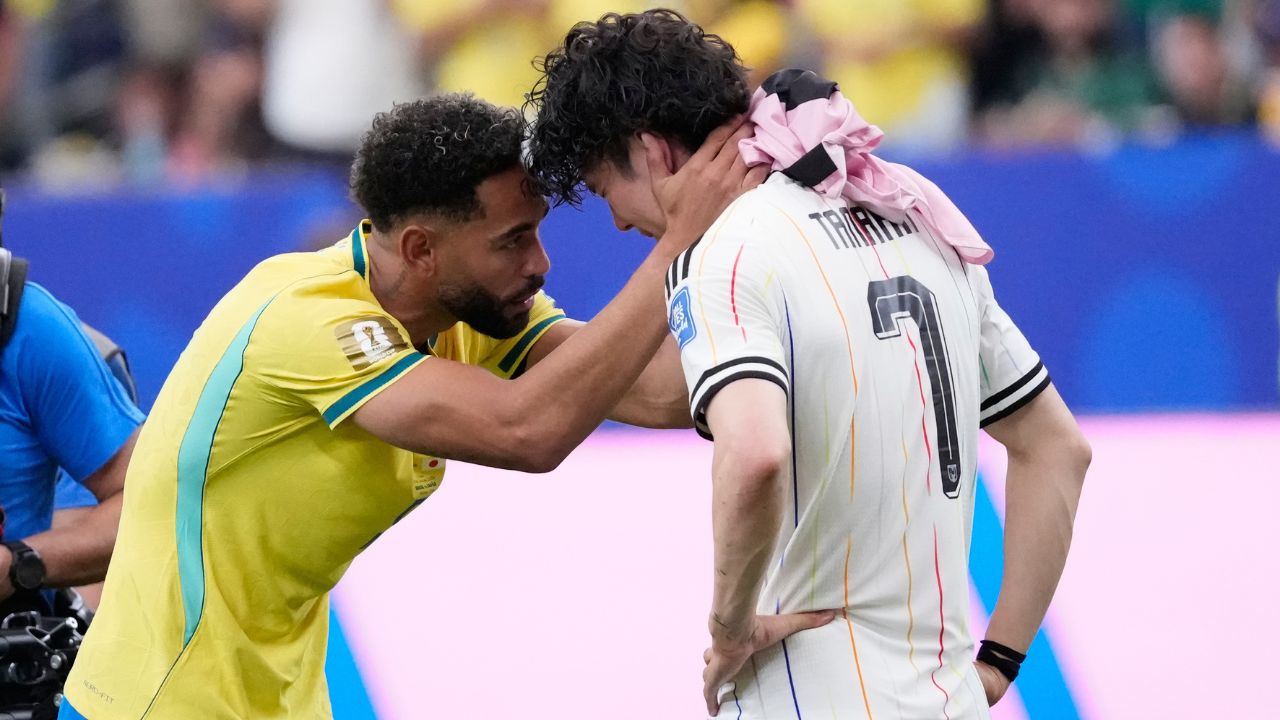
Brazil’s Matheus Cunha consoles Japan’s Ao Tanaka at full-time. (AP Photo/David J. Phillip)
Gabriel Martinelli and Brazil left it very, very late in Houston.
1. Orlando Gill (Paraguay)
Move over, Roque Santa Cruz; you have company in the pantheon of Paraguay’s greatest players. Gill’s heroics during the penalty shootout will overshadow his strong overall game, in which he made six saves and kept his team organized as Germany’s onslaught in the second half intensified.
2. Matías Galarza (Paraguay)
Perhaps the definition of a player you would love to have on your side, but hate to play against. Galarza was a beast throughout, making nine defensive contributions and 10 recoveries. His hijinks away from the ball also managed to frustrate the Germans.
3. Bruno Guimarães (Brazil)
Brazil’s maligned midfield simply has too much talent to look this inconsistent, but in the second half we saw what a good plan can do for great players. Bruno’s vision to see the pass for Martinelli’s winner was world-class.