

With two teams still battling it out in the Stanley Cup Final, this first week of June is also the start of the off-season process. The NHL Draft Combine is taking place in Buffalo and every team will be there to interview top prospects and see how they do in the drills at the end of the week.
The 2025-26 season was defined by parity and turnover, with several teams showing tremendous growth and opening up the beginning of a winning window. Even teams that extended long playoff droughts — such as San Jose or Chicago — took a positive step. Toronto, Florida, Winnipeg, New Jersey and Washington all thought they could have impactful seasons, then missed out on the playoffs, but will believe a return to the post-season is very much in play next season.
What every team will be figuring out right now is: “how do we get better this off-season?”
Those options are limited.

-
32 Thoughts: The Podcast
Hockey fans already know the name, but this is not the blog. From Sportsnet, 32 Thoughts: The Podcast with NHL Insider Elliotte Friedman and Kyle Bukauskas is a weekly deep dive into the biggest news and interviews from the hockey world.
Latest episode
The unrestricted free-agent pool is full of support players, but extremely light on high-end contributors. If the Buffalo Sabres get an extension in place with Alex Tuch before July 1, we’re looking at the possibility that Rasmus Andersson or Darren Raddysh are the top options, with Anthony Mantha or Boone Jenner left over as the best available forwards.
The trade market is still taking shape, but might be the best route to find a shake-up. With the salary cap rising again to $104 million, most of the league will have plenty of cap space. Ideally this will create the conditions for hockey trades as various teams look to make changes, but not necessarily for draft picks and prospects. Outside of a few teams (Calgary, Vancouver), most of the league today doesn’t seem to be in a rebuild mindset.
The draft, of course, is another area where improvement can happen, but that will generally be over the longer term. Perhaps a few players at the top of the class could step right into the NHL next season, but they can’t be counted on to be game-changing talents immediately. The best course of development for most of those players will be to return to the NCAA, Europe or major junior.
And then there is the rarely-used offer sheet. Every summer, we look for the potential carnage these can bring, but they are reserved for special situations.
We didn’t get any offer sheets last summer, but in 2024, the St. Louis Blues signed two of them with Philip Broberg and Dylan Holloway, who were both with Edmonton at the time. The Oilers, who had already used up most of their cap space in free agency, chose not to match either. Edmonton got second- and third-round picks as compensation, then watched both players blossom on their new team.
In 2021, the Hurricanes signed Montreal’s Jesperi Kotkaniemi to an offer sheet that was not matched, and was made in retaliation to the Canadiens signing Sebastian Aho to an (easily matched) offer sheet in 2019. Prior to that, you’d have to go all the way back to 2013 to find another one, when Calgary tried to pluck Ryan O’Reilly from Colorado.
The economic conditions in the NHL are changing, but how this affects approaches to offer sheets remains to be seen. After working under a relatively flat cap for six years, the upper limit is rapidly increasing now and is expected to continue doing so for years to come. That means far fewer teams will be pinched to the cap ceiling and could potentially make an aggressive offer on an RFA. However, it also means more teams will be able to match these kinds of offers.
So there are various factors at play. Will we see another offer sheet this summer? Let’s go over what you need to know about compensation, which teams might struggle with cap room, and which players may be interesting targets to consider.
What you need to know about offer-sheet compensation
First of all, here are the compensation thresholds for this season, based on the AAV of an offer sheet:
There are two important things to remember about the compensation. These require 2027 draft picks since the 2026 draft will have finished by the time offer sheets can be signed on July 1. And, the picks used as compensation have to be your own. Before the Blues successfully offer sheeted Broberg and Holloway, they made an off-season trade with Pittsburgh to re-acquire their own second-round draft pick so they could get the deals done.
If you sign a player to an offer sheet that requires compensation of multiple picks in the same round, you have more time to fulfill it. For example, if you have to give up two first-round picks for an offer sheeted player, you have three years to do so. If you sign a player to the highest compensation threshold and owe four first-round picks, you will have five years to honour it.
And finally, when an offer sheet is signed by a player, their team has seven days to either match or let them go for the compensation.
PuckPedia has a helpful tracker that allows you to sort by team and see which salary tier of offer sheet they could present an RFA, based on the draft picks they currently own. You can find that tracker here and view the table below:
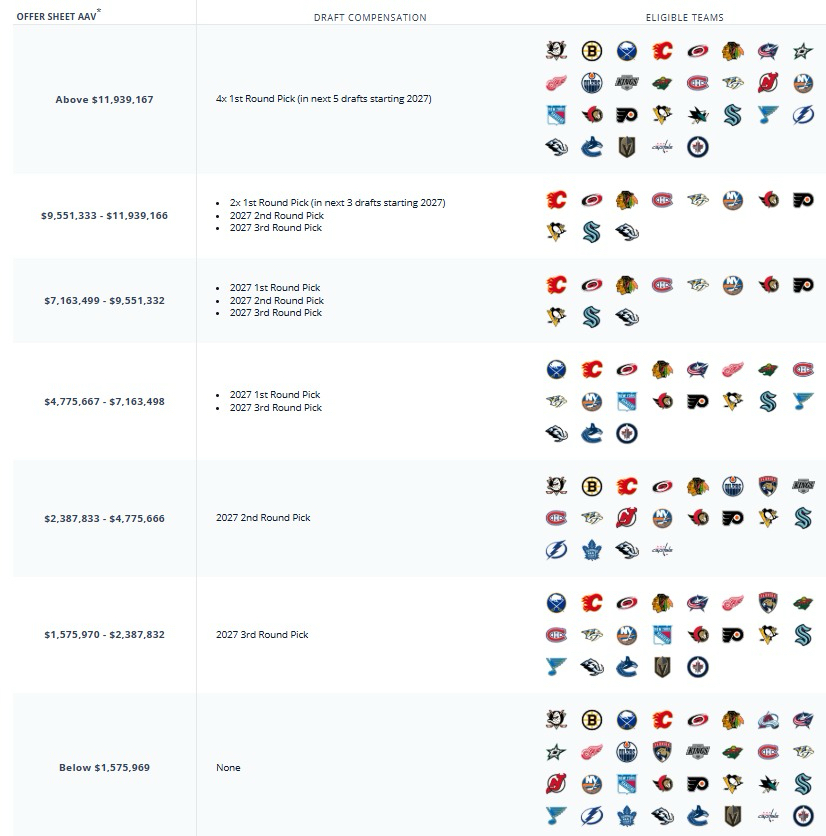
Which teams are tightest to the cap?
An offer sheet is a two-way street. A team can give one to any eligible player they have proper compensation for, but that player also has to agree to sign.
One thing to consider when looking for offer sheet candidates is which teams are tightest to the cap.
According to PuckPedia, the Colorado Avalanche currently have the least cap space in the off-season with just $2.98 million available under next year’s $104 million ceiling. Next is Vegas with $4.63 million in space, though it will likely put Alex Pietrangelo back on LTIR next season and regain his $8.8 million. No one else is within $10 million of next year’s salary cap.
However, we need to note a couple other teams. The Dallas Stars have $10.14 million in cap space, but re-signing RFA Jason Robertson would likely put them over and force them into other decisions. The Buffalo Sabres have $11.949 million in space, but re-signing pending UFA Tuch would put them somewhere around the ceiling.
Remember too: teams are allowed to exceed the salary cap by 10 per cent in the summer as they move pieces around before having to be compliant again in the fall. So any team is allowed to be $10.4 million over next season’s $104 million salary cap through the off-season. These teams would likely still be able to match an offer sheet and figure the other pieces out in July and August. But it could make things more complicated.
Potential offer-sheet candidates
So who are the possible candidates?
Let’s get some (probably) unrealistic ones out of the way.
Yes, Connor Bedard is a pending RFA and eligible for an offer sheet this summer. However, Chicago has $40.16 million in cap space and he is their centrepiece. Bedard didn’t sign an extension last summer, betting on himself to have a breakout, and he delivered with his first better-than-point-per-game season. The Hawks would have no problem matching any offer sheet, so odds are on the two sides coming to terms themselves.
Anaheim has $38.773 million in cap space and two very important forward RFAs to re-sign. Centre Leo Carlsson is offer sheet eligible after his breakout campaign and it is conceivable that another team could come in with a kind of long-term, big-money offer sheet that pays up for his future potential and bets on him being a franchise cornerstone. However, the Ducks likely see him the same way. Cutter Gauthier is Anaheim’s other important RFA forward, but he is not eligible for an offer sheet. That’s because he played one game to burn a year off his entry-level contract in 2023-24, so he did not accrue a year of professional experience.
There are some other, more realistic, potential targets and we should look beyond the biggest names who might be able to sign for the highest compensation bracket. Here are some other offer sheet candidates to consider:
As previously mentioned, if Buffalo re-signs Tuch, it would immediately be tight to next year’s salary cap. Meantime, 21-year-old Zach Benson became a core piece of the Sabres this season with a breakout 43-point campaign (in 65 games) and an even better showing in the playoffs. It might be fair to ask: Should Benson actually be Buffalo’s priority here? If Tuch signs first and Benson makes it to July 1 without a contract, would another team buy in on his potential and squeeze the Sabres with an offer in the $7,163,498 to $9,551,332 range, requiring compensation of first-, second- and third-round picks?
If not Benson out of Buffalo, we should also watch for Peyton Krebs’ offer sheet potential, or even Michael Kesselring, an arbitration-eligible defenceman on a stacked blue line.
The Stars’ top priority is to get Robertson under contract, which would be a big ticket, certainly in the $12 million range, that would put them over the cap. Meantime, the 24-year-old Bourque would be offer sheet eligible after his first 20-goal season. Perhaps a quiet playoff showing may cool interest in going the offer sheet route, and GM Jim Nill may be looking at trade options instead.
We should note that, of course, if Robertson makes it to July 1 unsigned, he would also be a major offer sheet candidate who would pull a contract from the highest compensation bracket, requiring four first-round picks. If it came to that, perhaps a trade would be the better route for an opposing team to go.
After scoring 35 goals last season, Dorofeyev reached 37 in 2025-26 and has added 10 goals in 17 playoff games. He’ll turn 26 in October and might be an intriguing offer sheet candidate to watch. After Vegas presumably puts Pietrangelo’s $8.8 million back on LTIR before next season, it would project to have $13.425 million in space, so it won’t be capped out after signing Dorofeyev, but he will take up a huge chunk of that. Vegas has four defencemen and nine forwards under contract for next season, with Rasmus Andersson their most notable UFA.
A contract in the $7,163,498 to $9,551,332 range (first-, second-, and third-round picks for offer sheet compensation) is a reasonable expectation for Dorofeyev and would force Vegas to think. Anything more than that would require multiple first-round picks coming back to the Golden Knights, but is there a team that would value Dorofeyev that much? It’s worth noting 20 of his regular season goals came on the power play, and that he ranked tied for 89th in the league by even strength goals.
If Vegas did want to match on Dorofeyev, or if it gets a deal done with him, there’s also the possibility it could seek to trade Adin Hill’s $6.25 million off the roster. Hill was one of the players included on Nick Kypreos’ most recent trade board.
With so many injuries on the roster this season, Florida’s hope was that the 23-year-old Samoskevich would break out with more opportunity, but his production stayed relatively flat. The Panthers are definitely a team to watch on the trade front this month, between the young Samoskevich and a valuable ninth overall pick that possibly could be used to improve an NHL roster that will have Stanley Cup goals again next season.
Florida has $15.277 million in cap space, but the biggest piece it has to resolve is in net, where it doesn’t have an NHL goalie signed. Will Sergei Bobrovsky be back, or will that position have to be dealt with through trade (perhaps Jordan Binnington?). A Samoskevich offer sheet would not be a high-end one, and perhaps the Panthers would consider accepting a second-round pick as compensation if another team bought into the potential in the $2.5-$3 million range. From Florida’s perspective, that pick might come in handy at next year’s trade deadline. For the player’s part, Samoskevich might see more opportunity for ice time elsewhere.
The Blue Jackets have $32.36 million in cap space, so they will not be up against it. However, 21-year-old centre Adam Fantilli is a pending RFA, eligible for an offer sheet, and a long-term extension for him wouldn’t come at a small number. If that situation gets contentious at all, he might be a target for another team, though Columbus has plenty of space to match on such an important player. Given how difficult it is to obtain young centres with oodles of potential, it seems most likely the Blue Jackets will get something done with Fantilli, or match an offer sheet.
What we wonder about, though, is the goalie. The 25-year-old, undrafted Jet Greaves played 55 games in his first full season with the Blue Jackets and was the ninth-best goalie by Goals Saved Above Expected, per MoneyPuck. He’s a potential goalie of the future for Team Canada, and had a 1.88 GAA, .920 save percentage and 6-2 record at this year’s World Championship. Again, Columbus has space, and Elvis Merzlikins’ $5.4 million AAV will come off the books after next season, but is there a team out there that a) believes Greaves is a surefire No. 1 worth taking a risk on and b) would present him an offer sheet worth enough money that would make Columbus uncomfortable and consider taking the compensation? Given how hard goalies can be to project, it might be a far-fetched idea that a team would give up multiple firsts for one, but Greaves does represent the top RFA goalie with a quickly rising stock.
With less than $3 million in cap space, the Avs are the most pressed to the ceiling and only have four defencemen under contract for next season. Brett Kulak is a pending UFA they may want to keep and after that, there won’t be wiggle room left.
Drury is a 26-year-old depth centre who won 58.1 per cent of his 969 face-offs this season, was one of Colorado’s main penalty-killers, and blocked 56 shots, the third-most among Avs forwards. He is coming off a contract that paid $1.75 million against the cap and will get a raise. Colorado already has Nathan MacKinnon, Brock Nelson, Nazem Kadri and Nicolas Roy, all capable centres. That depth allowed them to play Kadri on the wing. Now it might be a luxury it can no longer afford.
Centres, even bottom-six ones, are always in demand and the better route for Colorado — if it’s concerned about an offer sheet — would be to trade Drury before it gets that far. The Avs might be able to get a better return that way than if an offer sheet worth a second- or third-round pick in compensation is accepted by Drury.
Carlsson and Gauthier grab most of the attention in regards to Anaheim’s RFAs, but it also has two young defencemen who are offer sheet eligible. Zellweger and Mintyukov, two 21-year-olds, both finished with 22 points this season, while Mintyukov averaged about a minute-and-a-half more of ice time, mostly because of his shorthanded minutes.
Of the two, Zellweger may be the one to watch more closely on the offer sheet front. His average ice time dropped by nearly two minutes from 2024-25 to 2025-26 and he only played three playoff games for the Ducks.
According to Natural Stat Trick, at 5-on-5 this regular season, Zellweger’s individual expected goals of 7.35 was second-best on Anaheim’s blue line to Jackson LaCombe (7.72) and ranked eighth among all blue liners across the NHL. Zellweger’s individual scoring chances for at 5-on-5 were 15th-best among all NHL blue-liners. A team would have to pay up for his potential to even begin to make it uncomfortable for the Ducks to match, but he’s nonetheless a player to keep an eye on.
One of Montreal’s four RFAs, Bolduc scored 12 goals for the Canadiens this season but got to 19 with St. Louis the year before that. If he stays in Montreal, a new contract might come in the range of $3 million, but is there a team out there that values his potential higher than that?
When Montreal traded for Bolduc last summer, our scout Jason Bukala wrote that it had “acquired at worst a middle-six forward. He’s more likely a top-six winger.” That didn’t come to fruition right away, but Bolduc is still just 23 years old. If a team still sees him as a player who could score 20-25 a season and have top-six upside, might they take a shot on a short- or medium-term contract worth around $4.5 million — a rate that might make Montreal a little uncomfortable and require only a second-round pick as compensation?