

Every FIFA World Cup roster rollout always creates debate, and the decisions by some nations ahead of the 2026 tournament provide their own drama.
Whether it was established veterans, rising stars or players coming off strong club seasons, several notable names found themselves watching from home instead of representing countries that qualified for the tournament.
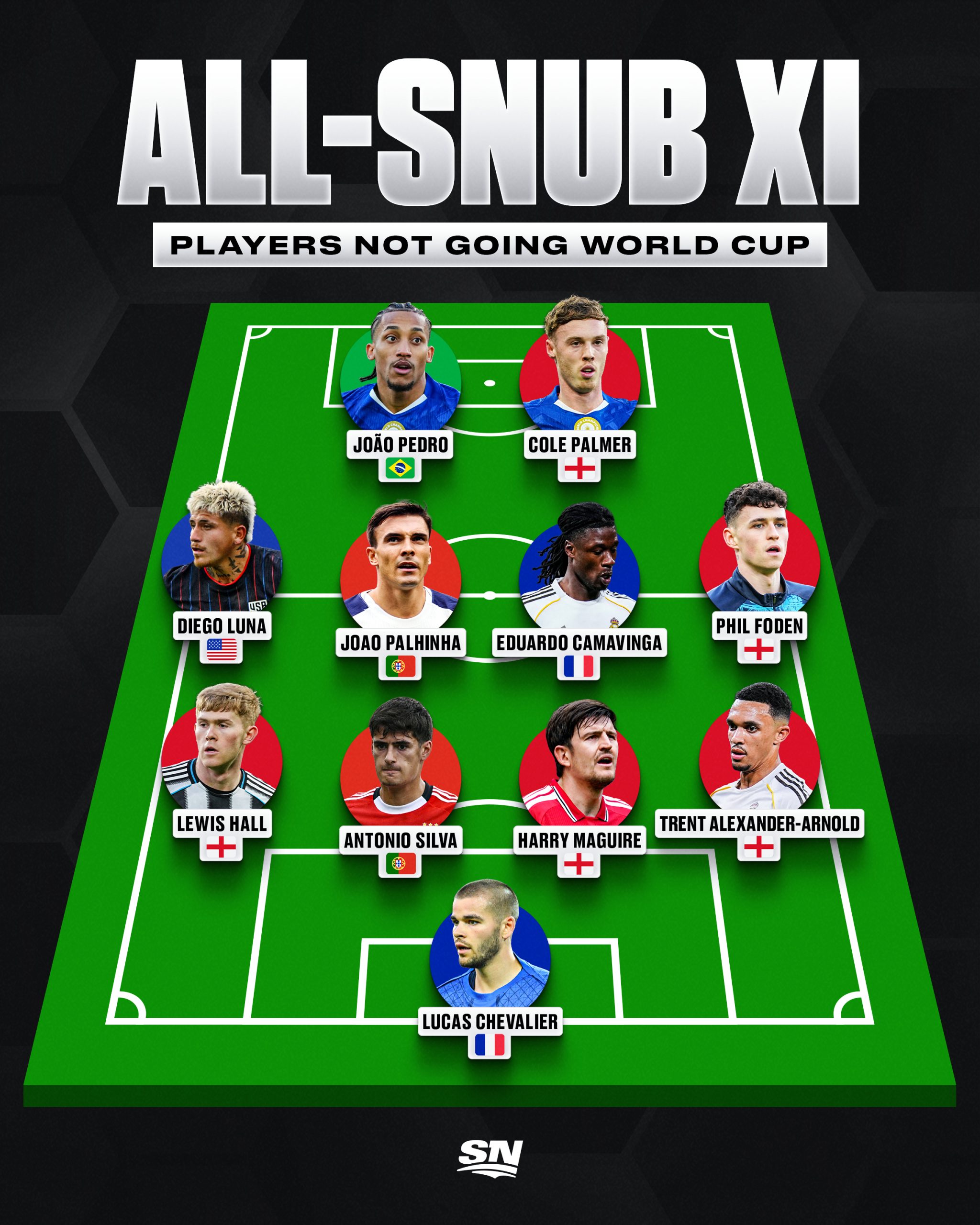
If those omissions were assembled into a single team, the result would be a squad capable of competing at the same level as many of the nations that made the World Cup field. Here’s a look at the 2026 FIFA World Cup all-snub starting XI and why each player’s absence came as a surprise.
Defenders
Few omissions generated as much surprise as Hall’s exclusion from England’s World Cup squad.
The 21-year-old enjoyed a breakout season with Newcastle United, establishing himself as one of the Premier League’s top young full-backs and earning a nomination for the Young Premier League Player of the Season award.
What made Hall’s omission particularly difficult to understand was not simply his form, but the composition of England’s squad. Hall had consistently demonstrated his ability to perform against elite opposition, most notably during Newcastle’s clash with Barcelona in the Champions League, when he went toe-to-toe with one of the world’s most dangerous attackers in Lamine Yamal and kept him mostly under control.
Had Hall missed out because England selected multiple specialist left-backs ahead of him, the decision would have been easier to justify. Manchester City’s Nico O’Reilly had emerged as a strong candidate following an impressive campaign, while early speculation suggested Arsenal’s Myles Lewis-Skelly would also be included. In that scenario, the debate would have centred around the preference between several highly rated young left-backs.
Instead, the controversy intensified when it emerged that Djed Spence had been selected while Hall was left at home. England’s decision to travel with only one natural left-back raised legitimate questions about squad balance and depth. Given Hall’s form throughout the season, many felt he had earned his place on merit.
The exclusion of the Benfica defender was certainly a puzzling decision by Roberto Martínez.
For the past two seasons, the young center-back was regarded as an important piece in the national team’s defensive transition. However, a late-season shift in momentum with Benfica appeared to be the downfall for his international aspirations.
As the season progressed, veteran leader Nicolás Otamendi and fellow academy graduate Tomás Araújo frequently squeezed Silva out of the starting lineup. Despite still logging over 3,000 competitive minutes across 41 appearances, the slight dip in his weekly playing time came at the worst possible moment.
Despite the devastating blow, Silva’s tournament story is not entirely written. Recognizing the public backlash and the player’s undeniable quality, Martínez has made it known that the 22-year-old would likely be Portugal’s first choice for an immediate call-up, should any selected defender suffer a pre-tournament injury.
Expressing that he was “shocked and gutted” by the omission, Maguire believed his resurgent domestic campaign had earned him a major role this summer. For Maguire, this marks a devastating second consecutive major tournament miss, having sat out Euro 2024 with a calf injury. It is a bitter development for a veteran of 66 caps who was central to England’s deep runs at the 2018 and 2022 World Cups, as well as Euro 2020.
With Manchester United, Maguire had to work his way back to a prominent role after he was stripped of the captaincy by Erik ten Hag in 2023 and fell entirely out of favour. The veteran refused to leave, and eventually earned the trust of Michael Carrick.
However, Tuchel’s ultimate selection criteria emphasized international continuity over recent club form. While Tuchel publicly admitted he was surprised by the raw emotion of Maguire’s statement, he defended his decision by pointing to tactical loyalty.
The German manager revealed that his final defensive hierarchy was built entirely on the central defenders who successfully carried England through the critical qualifying matches. For Tuchel, the steady reliability of John Stones, Dan Burn, Ezri Konsa and Marc Guéhi during international camps created a cohesive unit that he simply refused to disrupt, regardless of how well Maguire played in his friendly appearances against Japan and Uruguay.
The manager’s preference for players who excelled in his system throughout the year explains not just Maguire’s omission, but a broader tactical philosophy that also led to Trent Alexander-Arnold and Lewis Hall being left out.
Trent Alexander-Arnold, England
Under Tuchel’s tenure, the Real Madrid right-back was consistently treated as an outsider, registering a solitary 26-minute cameo against Andorra as his entire competitive output for the new manager.
Alexander-Arnold’s high-profile summer transfer from Liverpool to Real Madrid was supposed to elevate his career to a new stratosphere, but it inadvertently disrupted his international rhythm. Struggling with intermittent fitness issues and a dip in consistent domestic form in Spain, he failed to earn a single England call-up throughout the entire season.
Ultimately, this omission leaves Alexander-Arnold watching his third consecutive World Cup cycle on the outside looking in.
Midfielders
Diego Luna, United States
The omission of the Real Salt Lake star from Mauricio Pochettino’s final 26-man U.S. squad stands out as the single most jarring and modern controversy of the tournament selection cycle.
Luna had blossomed into a massive fan favourite during the 2025 Gold Cup, and had a strong start to the 2026 MLS season, with four goals and an assist in just nine matches.
What makes Luna’s exclusion uniquely bizarre is the unprecedented disconnect between what’s happening on and off pitch for the U.S. team.
For months leading up to the tournament, Luna was utilized as a primary face of the U.S. World Cup rollout. He was a central figure in Nike’s viral kit launch campaigns, starred in televised Head & Shoulders advertisements, and was even prominently featured in Panini’s official tournament sticker collections.
Portugal has a tough squad to crack, especially with a stacked midfield, but many thought Palhinha would be included, given his ability to provide defensive stability in the centre of the pitch.
Considering Portugal’s abundance of attacking talent, Palhinha offered a unique profile that complemented the squad, and at 30 years old, there is also the possibility that this represented his final realistic opportunity to play a major role at a World Cup, which only adds to the disappointment surrounding the decision.
Leaving behind a midfielder with Palhinha’s experience, leadership and defensive qualities will be something to watch as Portugal looks to go deep in the tournament.
Eduardo Camavinga, France
There were some eye-raising omissions from France’s roster but the one that got a lot of attention was the decision to leave Camavinga off Didier Deschamps’s final 26-man squad.
Having featured as a dynamic catalyst in France’s thrilling run to the 2022 World Cup final in Qatar, the 23-year-old was widely expected to be a permanent fixture for Les Bleus for the next decade.
However, a tough season with Real Madrid led to Deschamps noting that Camavinga was coming off a difficult season where he simply played less, while emphasizing that the internal competition within the French midfield pool is incredibly fierce.
By selecting dependable options Manu Koné, Warren Zaïre-Emery and Aurélien Tchouaméni, Deschamps opted for stability and prioritized players who appear to be in better form.
Foden may be the most talented player left off England’s squad because, at his best, the Manchester City star is widely regarded as one of the world’s elite attacking midfielders.
Foden arrived at the end of a difficult season by his own high standards. After playing a key role in Manchester City’s success over recent years, he struggled to find his best form during the 2025-26 campaign and saw his influence diminish as the season progressed.
Manager Thomas Tuchel gave Foden opportunities to stake his claim during recent international windows, but he was unable to produce the kind of displays that had made him a regular fixture for England over the years.
Still, leaving behind a player with 49 international caps and experience at the 2022 World Cup and both the 2020 and 2024 European Championships was always going to attract attention.
Forward
The Chelsea forward was coming off the best season of his career, recording 20 goals and 12 assists across all competitions while being named Chelsea Men’s Player of the Season. Unfortunately, that wasn’t enough to secure a place in Carlo Ancelotti’s squad.
He had been involved in three of Brazil’s previous four squad selections and scored 32 goals since arriving at Chelsea, which led many to believe he was a near-certain selection.
Instead, Pedro found himself off the roster, which was surprising, given Brazil’s decision to include Neymar despite the veteran forward not having made a national team appearance in nearly three years.
Ancelotti admitted that Pedro had probably done enough to deserve a place, but argued that other players offered different characteristics that created a more balanced squad.
Although Ancelotti’s explanation may have softened the criticism surrounding the decision, Pedro will now have to wait to make his World Cup debut.
Palmer looked like the future of England’s attack after emerging as one of the Premier League’s most exciting young stars following his move to Chelsea.
However, the 2025-26 season proved to be a frustrating one. A groin injury sidelined Palmer for a significant stretch early in the campaign, while further setbacks involving his toe, thigh and hamstring disrupted any chance of building consistent momentum.
Palmer finished the season with 10 goals in all competitions, a notable drop from the 25 and 18 he scored in his first two campaigns at Stamford Bridge. With England’s attacking positions among the most competitive in world football, a dip in production came at the worst possible time.
Chelsea interim manager Calum McFarlane urged Palmer to view the omission from England’s roster as motivation rather than a setback. At just 24 years old, Palmer still has plenty of opportunities ahead of him with England.
Goalkeeper
After losing his starting role at Paris Saint-Germain, Chevalier entered the World Cup selection process with far less momentum than many expected. His reduced playing time ultimately hurt his chances, and by the time Deschamps finalized his squad, the goalkeeper had fallen out of the picture entirely.
While the decision may have been understandable given his circumstances, it was still disappointing for many French supporters. Chevalier’s talent has never been in doubt, and his previous rise suggested he was on track to become a regular part of the national team setup.
At just 24 years old, Chevalier still has plenty of time to rebuild his position with both club and country. However, given the trajectory he appeared to be on not long ago, his omission remains one of the more surprising stories surrounding France’s World Cup squad.
Honourable Mentions
Several other players narrowly missed out on making this all-snub lineup.
Franco Mastantuono’s exclusion stood out, given the excitement surrounding one of Argentina’s brightest young prospects. Alejandro Balde was another difficult omission after establishing himself as one of Spain’s top young full-backs. Belgium forward Loïs Openda also had a strong case after consistently producing goals at club level, while Morgan Gibbs-White’s creativity and versatility made him a popular choice among England supporters.
Forwards
João Pedro (Brazil)
Cole Palmer (England)
Midfielders
Diego Luna (USA)
Joao Palhinha (Portugal)
Eduardo Camavinga (France)
Phil Foden (England)
Defenders
Lewis Hall (England)
Antonio Silva (Portugal)
Harry Maguire (England)
Trent Alexander-Arnold (England)
Goalkeeper
Lucas Chevalier (France)
Honourable Mentions
Franco Mastantuono (Argentina)
Morgan Gibbs-White (England)
Alejandro Balde (Spain)
Loïs Openda (Belgium)