

Sonny Sekhon still remembers the moment it took hold, this love that’s governed the past three decades of his life.
He was four years old, sitting on the couch beside his grandfather in his family home in Edmonton. The Oilers were on the TV, and the city, in 1990, was still basking in the glow of a dynastic run that had seen the club amass five Stanley Cups in seven years.
“My dad’s dad, he came to Canada in 1983. I don’t know what the fascination was, I don’t know why he was so quick to gravitate to the Oilers,” Sekhon says. “My uncles, they all play field hockey, so that was one theory. The other theory is just that it was the ’80s Oilers — how could you not love them?”
Sekhon remembers seeing that love in his grandfather that day on the couch.
“I can remember it vividly,” he continues. “Watching these hockey games. I remember him yelling at the TV in Punjabi. This guy — who never saw ice in his life, didn’t speak English, wore a turban and had a full beard — I remember his passion for this game that at that point had probably no place for someone like him.”
Growing up in a city whose love for the sport had reached a fever pitch, Sekhon found himself at a rink a few years later, ready to take the ice for the first time. He got a sense then of his own place in the game, too.
“I remember going to my first-ever tryouts,” he says. “My actual legal name is Harinder Singh Sekhon — Sonny is my [nickname]. And I remember going to Clare Drake Arena, my mom dropping me off. I’m all ready to go, and the coaches come in and do a roll call. You know, it’s ‘Brady,’ ‘Matt,’ very Canadian English names — and then the instructor says ‘Harinder.’ And these kids start giggling. And I just remember feeling upset. I remember sitting in the room and crying.”

But in the same moment he first felt the game’s ability to push him away, Sekhon felt its capacity to bring a room together, too, when the father of another kid at the skate came over to offer some words of encouragement.
“He sat beside me on the bench and put his arm around me, and he just told me about how much he loved the game,” Sekhon says. “He said, ‘You know, I bet you’re going to get out there and I bet you’re going to love it. And if you don’t, that’s okay.’ So, I bought in, I was like, ‘Yeah, I’ll give it a try.’
“And here we are, 33 years later, talking about why I love the game.”
In those 33 years, Sekhon’s passion for the sport has become a foundational piece of his life in Edmonton. On Monday, he was announced as one of three Canadian finalists for the NHL’s Willie O’Ree Community Hero Award, an honour granted by the league to those who positively impact their community through hockey.
Sekhon’s nomination comes as a result of his role in founding the Punjabi Elite League, a ball hockey program in Edmonton aimed at fostering connection within the city’s Punjabi community and creating opportunities for Punjabi youth in the sport.
The seeds of the league were first planted eight years ago, when Sekhon and some friends started organizing three-on-three ball hockey tournaments in Edmonton as an off-shoot of a larger tournament held down the road in Calgary. A league eventually took shape, the Punjabi Ball Hockey League, run by others in the community, bringing together hundreds of players — including Sekhon, who suited up as a captain for one of the PBHL’s squads.
Then, in 2025, a plot twist thrust Sekhon into a far more central role.
“I wasn’t even playing anymore — I have a small son, my focus was him,” he says. “It was April 1st — I thought these guys were playing a joke on me. I was standing in the lobby of the Bellagio [in Las Vegas], I was going to the Oilers game that day, and my phone starts to ring. One after another, I’m getting phone calls from different captains in the PBHL and they’re saying, ‘Check your email, check your email.’ Out of nowhere, the league had decided to fold.”
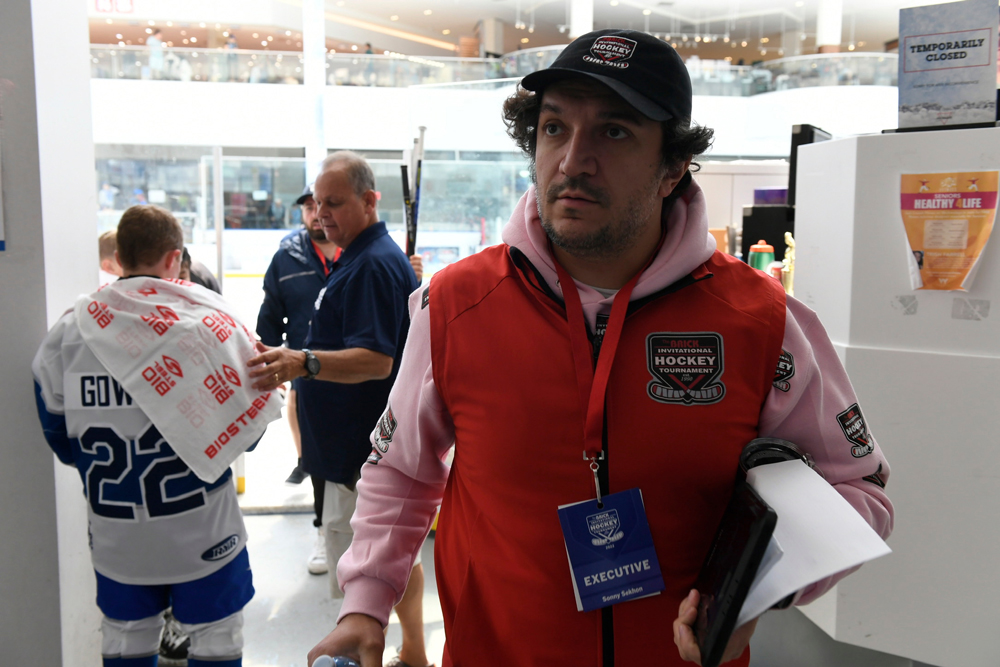
Sekhon, who’s long been involved in community organizing in Edmonton and has spent a decade-and-a-half helping to organize the city’s hallowed Brick Invitational Hockey Tournament — which hosted the likes of Steven Stamkos, Auston Matthews and Macklin Celebrini as 10-year-olds — was called on to chart a path forward.
“That’s where the [Punjabi Elite] League started,” Sekhon says. “I already had all this infrastructure from the tournaments. … I didn’t promise anything, but I said I would try. We had a very tight turnaround. And it’s a very expensive venture to start a league.
“But we made it happen.”
It wasn’t easy. Logistics aside, there was also life to deal with. Sekhon’s young son was navigating some health issues at the time. The family was stretched thin, looking for answers.
If Sekhon was going to take on trying to fill the gap left by the PBHL, he knew he couldn’t do it alone. He reached out to Arjun Atwal, a junior hockey and USports standout who’s heavily involved with Edmonton’s community sports scene as well — and a former O’Ree Award nominee himself — to help get the new league off the ground.
“The first two weeks were such a blur,” Sekhon says. “It was a lot of us calling anyone we knew. A lot of phone calls asking for favours, trying to get ice time, trying to get floor time, trying to find referees. No exaggeration, literally hundreds of hours combined. … We knew that if we could pull it off and we could just get it going, then we could sustain it. So, we put everything we could into it.
“We’re in Season 2 now. The games are going on — we’ve got five games tonight, five games tomorrow. We love it.”
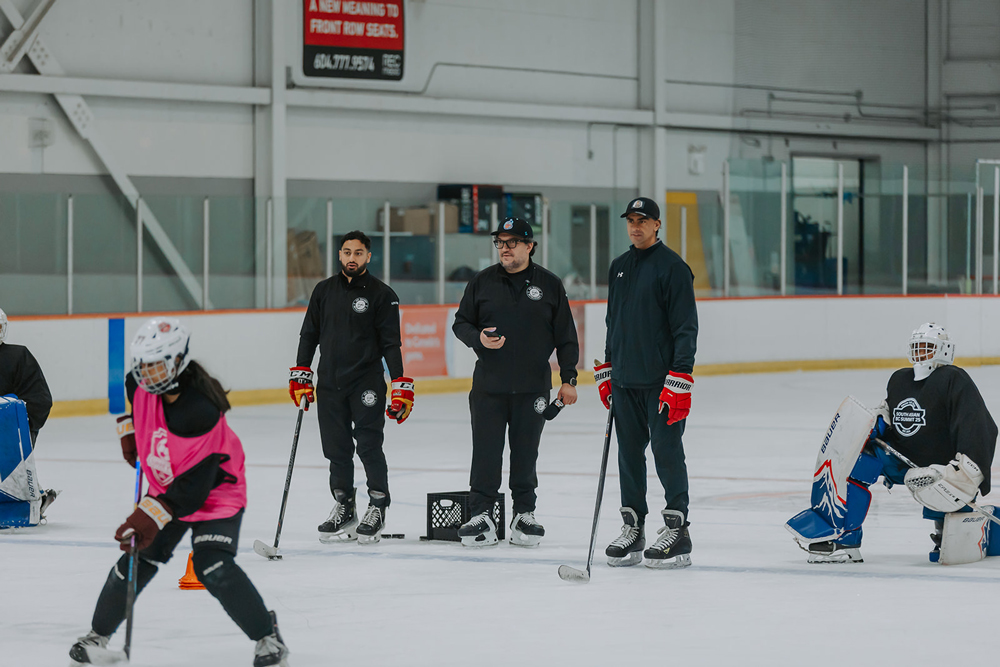
Now in full flight, the Punjabi Elite League consists of eight teams, each run by its captain, the rosters sorted through a live draft. Players can be traded, and there’s a waiver wire in case injuries shake up a roster. The squads play a 14-game season, with a social-media team working to tell players’ stories along the way.
The goal for the future is to keep building — the league is planning on expanding to add a women’s hockey season and growing its programming for kids. And while the PEL charges for men’s hockey, on par with other men’s leagues in the city, all its current programming for women’s hockey development and youth hockey is free, says Sekhon.
The impact has already been clear to Sekhon in the kids he’s seen fall in love with the game like he once did.
“You just see the growth and development in the players. You see them coming out of their shells,” Sekhon says. “We have one kid in our program — this is a guy that was a little nervous to play, took time away from the game, came to one of our summer summits, played ball hockey, played ice hockey, we did some seminars with him. And then this year he actually was the Rona Skater [at an Oilers game].
“We got to watch this kid who wasn’t sure if this was his jam — and he’s taking a warm-up lap with the Oilers flag and standing on the ice with the players. You know, it’s very surreal.”
For Sekhon, it goes beyond hockey. It’s about something more deeply rooted, a philosophy that’s long guided his understanding of what it means to be part of a community.
“I don’t go to the Gurdwara often, but I grew up in a Sikh family. And there’s a tenant [in Sikhism] — it’s called seva, which means selfless service to the community,” he says. “I always liked that. For me, the spiritual connection was always just doing work for the people around you. That was always in the back of my mind.”
It’s much the same story for the others helping to run the Punjabi Elite League, too.
“You can see that belief in seva echo through the whole league,” Sekhon says. “On April 1st this year, we had our largest kids’ game ever. We had 63 kids sign up and we had 47 show up. We anticipated we would have 30, so we were slammed. It was way more than me and Arjun could possibly handle ourselves. So, I put the call out, I sent a message to all the captains. To no surprise, every single captain came. We had our female coaches from the ice-hockey side come, we had sponsors come, we had parents of kids come. All of a sudden, we have like 75 people there — no one’s getting paid, people are taking half-days off work, no questions asked.
“Because they all also believe in seva, also believe that we have to do these things. We have to pay it forward. If no one’s willing to roll up their sleeves, these opportunities don’t just arrive for their kids.”
It’s not only the kids in the community feeling the impact of this work, though, this effort to expand the ideas of who the game belongs to and who belongs to the game. Sekhon got an unforgettable reminder of that a few years back, during a conversation with his father.
“My dad came from Ludhiana, Punjab, in 1974. You know, like so many stories, he took any job he could get — cutting grass, driving a taxi — and eventually made his way out west,” Sekhon says. “I remember three years ago, when the Oilers did their first-ever South Asian night, I requested they do a jersey with ‘Sekhon’ on the back and ‘74.’ … I tried to give it to him, and my dad was like, ‘No, no, you keep it. It’s yours.’ But I remember when he turned it around and he looked at the number, I thought he was going to cry.
“I think just, for him, within a generation, just being able to see his culture, see his son,” Sekhon continues, his voice breaking for a moment, overcome with emotion. “I just don’t think he ever would have imagined it.”
Sekhon’s hope is that one day these gestures won’t seem so moving, that the sport will get to a place wherein there will be no need for such displays of acceptance — no need, even, for the Punjabi Elite League.
“My long-term goal is to put myself out of business,” he says. “Because I would love to live in a world where we don’t have to organize community-based leagues, because everybody is just so accepted.
“But the need exists because that’s not the case. Until it is the case, I’m there. I’ll always be there.”