

Among the Miami Marlins’ emerging trio of young Canadian players, Liam Hicks may have been the least expected to break out in 2026.
Sporting less of an MLB track record and worse underlying numbers than the Montreal-born Otto Lopez, and less prospect pedigree than Burlington, Ont.’s Owen Caissie, Hicks profiled as a passable backstop with elite control of the strike zone, but not much more.
That he’s only a little over one year removed from joining the Marlins via the No. 2 pick in the Rule 5 Draft — after being left exposed to all 29 other teams by the Detroit Tigers — further highlights the Toronto-born backstop’s improbable success story.
Hicks entered play Wednesday ranked third among catchers in both home runs (11) and OPS (.820), and his 44 RBIs were tied for third in the majors — it’s also one off the 45 he amassed over 119 games during his 2025 rookie season.
So, how has this previously unheralded and relatively diminutive catcher with modest peripherals managed to make a sizeable leap in production?
Let’s dive into the changes behind Hicks’ breakout.
To start, it’s worth pointing out that despite his quality-of-contact metrics being quite poor, they have improved year over year. Hicks’ average exit velocity off the bat has increased by 2.4 m.p.h. and his hard-hit rate is up 7.3 percentage points, both top seven year-to-year gains from last season.
Still, he ranks in the 15th and 22nd percentiles, respectively, for both metrics. He’s barrelling the ball more often, but not significantly, and his 68 m.p.h. bat speed ranks in the bottom six per cent of MLB hitters. These aren’t exactly the makings of a star slugger.
The most notable mechanical change that Hicks has made is opening his batting stance an additional 17 degrees, from 20 degrees open to 37. Meanwhile, his pull percentage has increased from 39 per cent — roughly league average — to 42.2 per cent.
Hicks’ previously limited power has always been to the pull side, but when comparing the spray charts of his extra-base hits from this year to last, it’s plain to see there’s a pronounced shift.
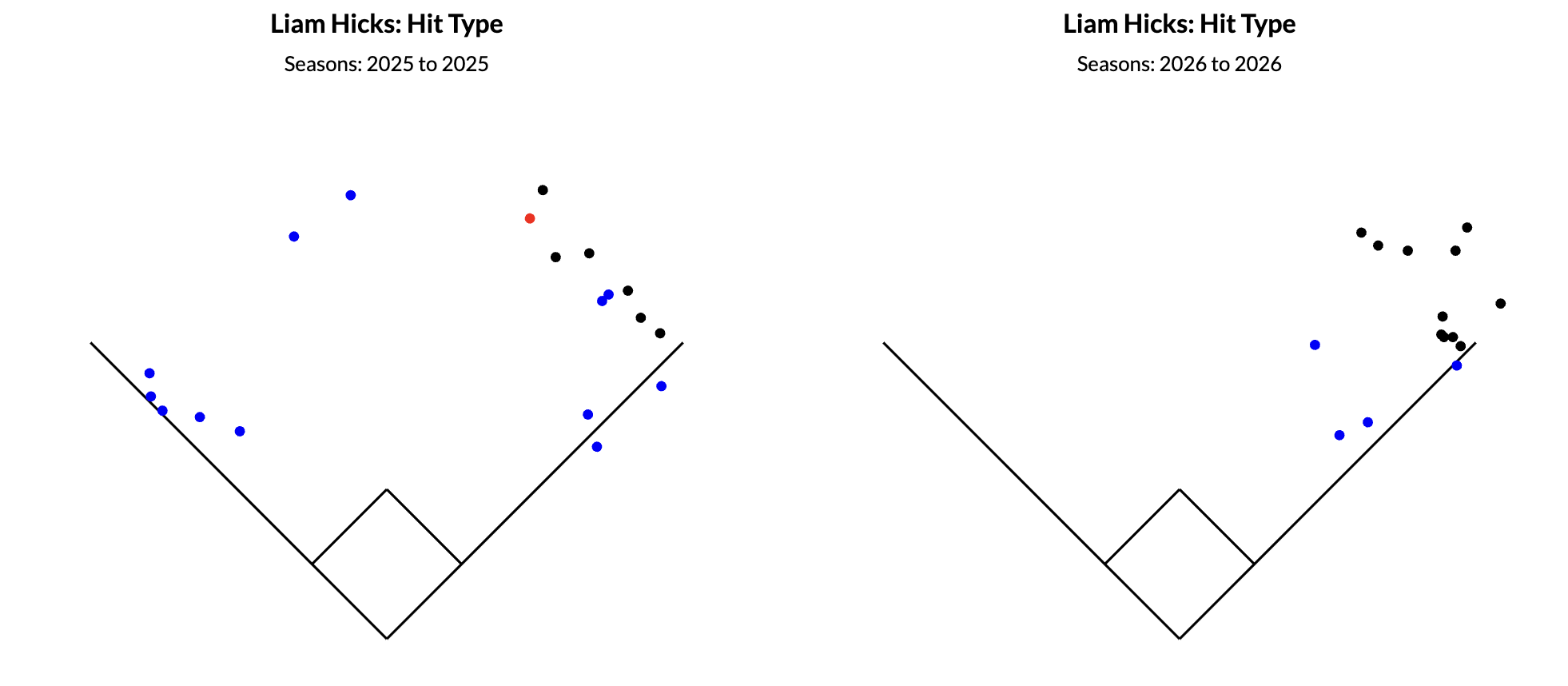
He doesn’t quite have the classic, Isaac Paredes-esque pulled-fly balls profile. Hicks’ pull air percentage is only 19.7 per cent. But it has increased 4.8 per cent from last season, and he’s hitting fly balls 6.6 per cent more often overall. He is both pulling the ball and hitting it in the air more often for better results.
Another significant adjustment has come against breaking balls. Hicks struggled against spin during his first season, slugging just .258, but has managed to mash movement in 2026 to the tune of a .757 slug.
The backbone of Hicks’ offensive game remains his top-end contact ability and discerning approach. He swings and misses on only 10.5 per cent of pitches, behind only contact savants Chandler Simpson, Steven Kwan and Luis Arraez, and he strikes out in just 9.2 per cent of his plate appearances, behind only Ernie Clement, Nico Hoerner and Arraez.
This elite bat-to-ball skill, combined with proficient plate discipline — Hicks has walked more than league average and chased less since entering the majors — gives him a sturdy floor. Now that he’s begun to access more power, not through raw ability, but rather through clever intent, Hicks boasts a unique combination of contact and slugging.
Yordan Alvarez and Yandy Diaz are the only other players with 80th percentile or better strikeout rates who have higher slugging percentages. Two players who play corner outfield and first base, respectively, when they aren’t the designated hitter.
It’s important to consider that Hicks is a primary catcher. While his 127 wRC+ this year indicates that he’s been 27 per cent better than a league-average hitter, the average wRC+ among catchers over the last five seasons is 90. So, he’s really even further above the standard for a premium defensive position.
That said, considering the rigorous physical demands that come with being an everyday catcher, the Marlins have opted to play Hicks more often at first base and DH this year. He’s split his appearances 26, 15, 15 between the three positions in 2026, respectively.
And while he’s only catching in 46 per cent of his appearances, compared to 55 per cent in 2025, his viability behind the plate is valuable. And given his rise in production, it makes sense that the Marlins are prioritizing keeping his bat in the lineup.
Hicks’ sensational start to his sophomore season was punctuated by his first-ever major league series in his hometown at Rogers Centre this week.
And while his Marlins ultimately dropped the series, Hicks worked a walk and added to his gaudy RBI total in his first big league game back on home turf Monday, an 8-2 win.
Both Hicks’ recent results and ability to make adjustments bode well for a long MLB career. One that could include many more visits back home.