

The lesson I’ve learned while on the road is that you never know where your next charge is coming from. That’s why I always bring a travel power strip, whether I’m on vacation or traveling for work.
For $20, it’s inexpensive peace of mind: a compact little four-outlet power strip with USB-A and USB-C connectors to boot, plus a four-foot-long cord that wraps up snugly around the unit when not in use.
More often than not, I’ve been in a hotel room where the outlet is hidden behind the bed, where the desk outlet doesn’t work, or where there’s simply a single outlet for everyone wanting to recharge their phones.
About two decades ago, Monster (remember them?) held a press conference at CES to announce new gold-plated HDMI cables or some other high-end audio nonsense. But one of the things they showed off, almost by accident, was its own travel power strip.
This has to be the dumbest thing I’ve ever seen, I thought to myself. But their communications person convinced me to try it out and I used it over and over and over on that trip and others until it finally gave up the ghost.
I eventually chose this Orico power strip because I liked the shape and weight. It’s about 1.6 inches thick, so it’s a bit chunky, but otherwise takes up about the space of a smartphone. The four-foot-long cord wraps neatly around the power strip, and you can secure it with the included elastic band. The angled 45-degree plug just plugs into itself for storage.
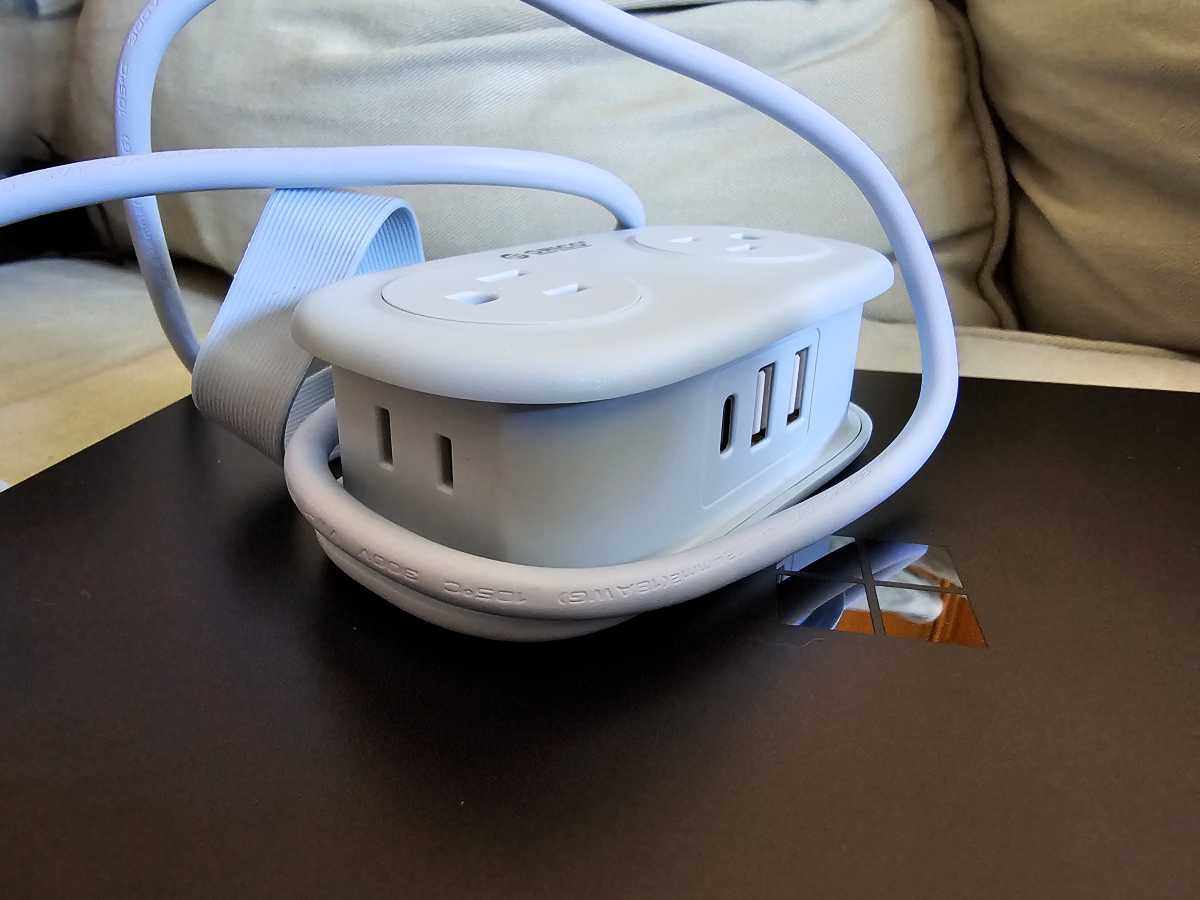
Mark Hachman / Foundry
From a power perspective, it’s rated for 1,250W of power. Most laptops consume about 100W. There are two three-pronged connections, two two-pronged connections, two USB-A ports, and a USB-C port with 15W of charging power. (If you need more power from the USB-C port for fast-charging the latest phones, Orico sells an upgraded model for $31, though with fewer electrical plugs.)
There’s another consideration: Orico’s power strip does not have surge protection. That’s both good and bad. Cruise ships ban surge protectors because of their own built-in electrical systems. However, a surge protector can be useful if you’re traveling in regions where thunderstorms are a possibility. If that’s the case, consider the $13 One Beat surge protector, with a similar design and even more plugs. It’s a bit chunkier and the cord doesn’t wrap up as conveniently.
Finally, there’s the color! I bought mine in blue for one good reason: everything in tech is colored either black or white. Sure, it looks nice, but a bit of color means it’s easier to find in a crowded backpack, briefcase, or suitcase. There’s white, black, blue, and even lilac to choose from and no power LED to keep you awake at night, either.
I think it’s a must-have device for working on the road. And, as a small bonus, Amazon’s offering 10 percent off right now!