


Megan Ellis / Android Authority
TL;DR
- Claude Sonnet 5 is designed to tackle multi-step tasks more independently, with support for web browsing, planning, and developer tools.
- The new model promises near-Opus 4.8 performance at a lower cost, while improving on Sonnet 4.6 in reasoning, reliability, and safety.
- Sonnet 5 is now the default model for Claude’s Free and Pro users, with built-in cyber safety protections enabled.
AI models are arriving at such a rapid pace that it’s becoming difficult to keep track of who’s leading the race. Just when you’ve gotten used to one, another arrives promising to be smarter, faster, and cheaper. The latest entrant is Claude Sonnet 5, which aims to deliver near-flagship AI performance without the premium price tag.
That matters because most people don’t care about benchmark scores alone. They care about whether an AI can actually finish a task without constant hand-holding. Sonnet 5 is built with that in mind. Anthropic calls it “the most agentic Sonnet model yet.”
Instead of simply answering questions, it can plan multi-step tasks, browse the web as needed, use developer tools such as terminals, and work more independently.
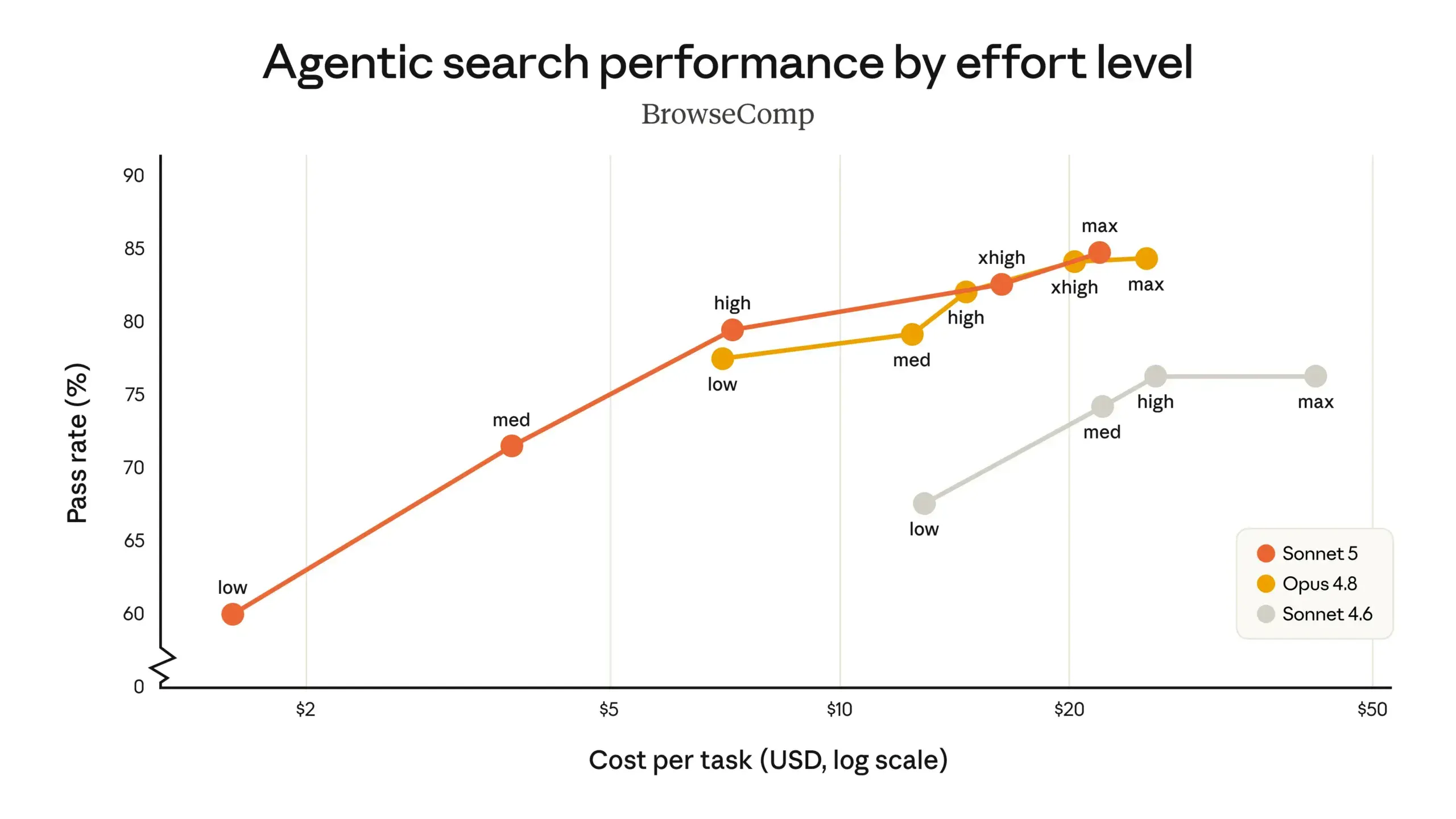
Sonnet 5 is also said to narrow much of the performance gap with the more powerful Opus 4.8 model while costing considerably less to run. Performance charts shared by Anthropic clearly show it consistently outperforming the previous Sonnet 4.6 model and matching Opus 4.8 on certain tasks when users increase the model’s “effort” setting.
Beyond raw performance, the focus is also on making the model more reliable. Sonnet 5 is designed to better detect and reject malicious instructions, including prompt-injection attacks that try to manipulate an AI into ignoring its original task. It’s also better at avoiding hallucinations and is more willing to challenge incorrect assumptions rather than simply telling users what they want to hear.
Following the discontinuation of Fable 5, Sonnet 5 comes with cyber safety protections enabled by default. These safeguards are designed to detect and block harmful cybersecurity-related misuse while remaining less restrictive than those introduced with Fable 5, which imposed tighter limits on security-focused requests.
Claude Sonnet 5 is rolling out as the default model for Free and Pro users, while Max, Team, and Enterprise subscribers also get access. Developers can use it through Claude Code and Anthropic’s API platform. Introductory API pricing is set at $2 per million input tokens and $10 per million output tokens until August 31, 2026. After that, it’ll increase to $3 and $15 per million input and output tokens, respectively.
Thank you for being part of our community. Read our Comment Policy before posting.