

Nvidia’s latest chip is splashed all over the news right now, and for good reason. On Sunday, Team Green took the wraps off its first consumer processor for PC laptops and desktops. Known prior to launch by its codename N1X, the RTX Spark became official during CEO Jensen Huang’s keynote speech at Computex 2026. The beefy APU combines a 20-core Arm-based CPU with a 6,144 CUDA core Blackwell GPU—an astronomical step up from the custom Tegra processors the company designed for the Nintendo Switch and Switch 2, as well as its own Shield devices.
Microsoft is one of Nvidia’s more prominent partners, with two Surface devices featuring the RTX Spark: The Surface Laptop Ultra and the Surface RTX Spark Dev Box, both announced this week during Build 2026, the company’s annual developer conference.
I was invited to see both these devices in person for a short set of real-time presentations. While the ferocious capabilities of the machines stood out clearly, as did meticulous design details of each, something else stole my attention.
The Windows demo.
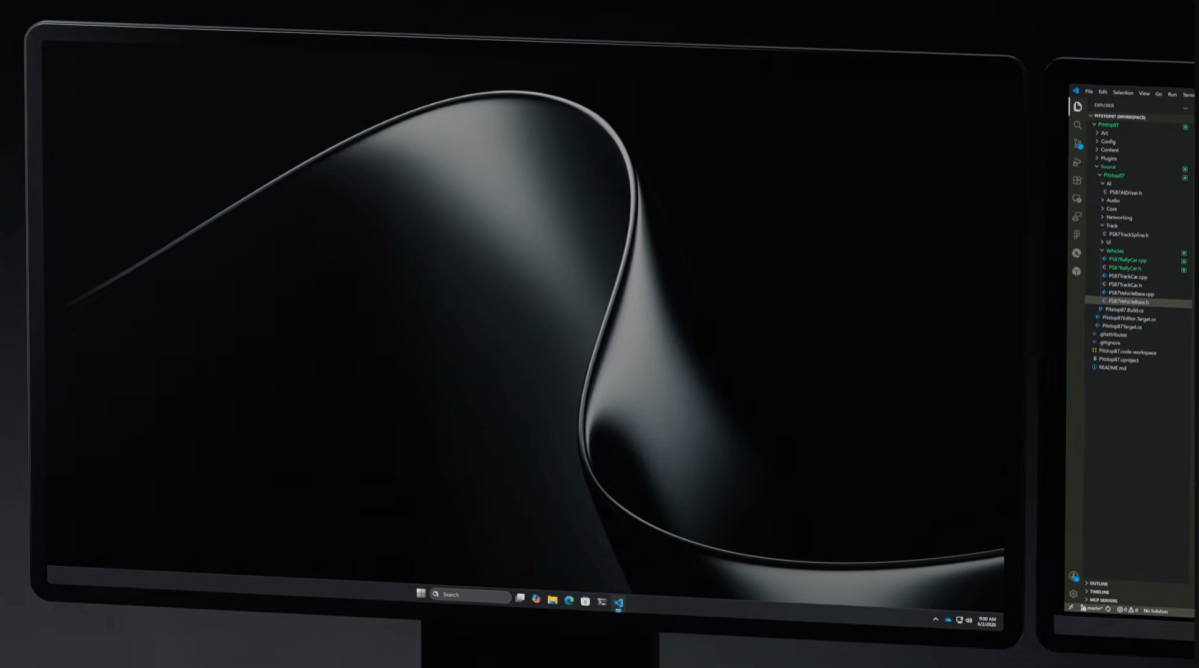
The default background in the developer version of Windows appears to be very understated.
Microsoft
These coming Surface devices ship with a developer version of Windows, one streamlined for what Microsoft calls a distraction-free environment out of the box. Widgets? Removed. Notifications? Quiet. Keyboard functions have also been prioritized, and you can quickly kill misbehaving apps via Windows’ right-click context menu—Microsoft added an End Task command as an option. The promised ability to snap windows to any edge of the screen is an easy tweak in the settings. Even the desktop wallpaper is subdued, a marbled swirl of grey and black.
I have long hoped for an unfussy, uncluttered Windows. Sure, some consumers want the current default experience. I belong to a different, long-underserved group. Folks who want to get up and running quickly, without the need to turn off this and that, tweak a dozen settings, even install extra apps to surface buried features. Change the wallpaper to something less distracting. Windows 2000 remains my favorite version of the operating system, and I was never someone who needed a server environment. It was straightforward, its commands directly accessible, with rock-solid dependability.
Alaina Yee / Foundry
I doubt I’d enjoy Windows 2000 in today’s era, though the positive emotional memory still lingers. In this modern world, where you can just type in a search box to bring up most things, I can live without manually hunting for settings (even if easily done). But its lack of fussiness? I still want that.
Microsoft’s representatives sounded receptive when I mentioned my interest in this dev version of Windows, especially if adjusted a bit for a non-developer. Andrew Hill, Corporate Vice President of Surface, said during our chat that both the Surface Laptop Ultra and the Surface RTX Spark Dev Box aren’t purely business devices—they’re for consumers, too. So maybe there’s room for a less obtrusive Windows that lives a smidge closer to the consumer side. (Maybe this dev version of Windows could have setting profiles…?)
If you agree with me, let Microsoft know. They seem to be listening these days.