

Summary created by Smart Answers AI
In summary:
- PCWorld reports on Intel’s Project Firefly initiative, which aims to bring premium laptop features like all-metal construction and fanless design to budget-friendly devices.
- The project centers on Intel’s new Core Series 3 ‘Wildcat Lake’ processor, engineered with cost-reduction technologies and simplified motherboard designs to make laptops more affordable.
- Major manufacturers including Dell, HP, Lenovo, Acer, and Asus will ship these reimagined mainstream laptops targeting students and small businesses.
People everywhere are talking about Apple’s cheaper MacBook Neo laptop. Now Windows is preparing to retake the mainstream laptop market with Project Firefly, inspired by smartphone design.
Firefly aims to deliver characteristics associated with premium laptops like all-metal construction and a clean underside, free of ventilation. Inside sits Intel’s Core Series 3 series, aka “Wildcat Lake,” a chip that Intel re-engineered to remove manufacturing cost, thus lowering the cost of the finished laptop. Intel also showed off a processor module with memory chips designed for phones rather than PC.
“We call it mainstream reimagined,” said Sam Gao, vice president and general manager of Intel’s software and client product group in China. Firefly laptops will be designed for a “day of productivity” for students and consumers, including small business customers.
“About a year ago, a few of us got together and we thought, we have a good recipe for this premium segment of products,” Gao said. “What happened to the more mainstream designs? What if we look at this segment from a new angle, not only competing on how not only how much it costs you to get a system, but what kind of experience you will get? How thin that system can be, how quiet it can be, how long a battery life it can [have]. Let’s do this differently. Let’s reimagine mainstream.”

Intel
First Athena, now Firefly?
In 2019, Intel launched “Project Athena,” a reimagining of the premium laptop. Over time, that code name became the basis of the Evo brand. Not only did it represent a quality product, but it also signaled the close collaboration between laptop designers and Intel engineers. It’s not clear that Project Firefly could head in the same direction, but history suggests it might.
Intel, strangely, is completely downplaying the connection between Wildcat Lake, Firefly, and what effects it might have on the laptop market. At least one Wildcat Lake system was available at CES 2026 in January, but Intel barely promoted the chip’s launch in April, after a major CES event focused on the Core Ultra Series 3 (Panther Lake). At Computex, however, my colleague Adam Patrick Murray reported that vendors were eager to show off Wildcat Lake systems, even if Intel wasn’t. A recent video published by the Intel Technology channel represents much of what we know about Project Firefly so far.
Gao denied that Project Firefly was released in response to the MacBook Neo, which makes sense. In mid-2025, prices of memory and storage started skyrocketing upward, and Intel was in the right position to recognize and respond to the trend. Gao said that Project Firefly began about a year ago, and that Firefly systems began circulating at CES 2026 in just about three months’ time.
So why Wildcat Lake? Nish Neelalojanan, the senior director of client products at Intel, said that the processor was designed for lower-cost laptops from the beginning. It has two performance cores, four low-power efficiency cores, and two embedded graphics cores. More importantly, Intel did away with the “tiled” chip architecture that traded manufacturing flexibility for additional cost, making it based on Intel’s in-house 18A process technology.
For Wildcat Lake, Intel also abandoned its Foveros interconnect, replacing it with a UCIE interconnect, and reduced the motherboard layers to six. Neelalojanan even implied that single-channel memory could be used to save cost. Intel also trimmed “the latest iteration” of Thunderbolt to reduce the end price, too, he said.
What’s in a Project Firefly laptop?
While Wildcat Lake might be the heart of Firefly laptops, the actual Firefly laptop reference design was worked in conjunction with China’s tech ecosystem, Neelalojanan said. Those companies were accustomed to stripping out as much cost as possible for China’s phone ecosystem, and Intel leveraged that as part of the Firefly designs. Neelalojanan called that a “recipe” for further innovation, and across the rest of the world.
“The program itself kick-started that platform innovation for this part of the segment, and you’ll see a lot more designs,” Neelalojanan said.
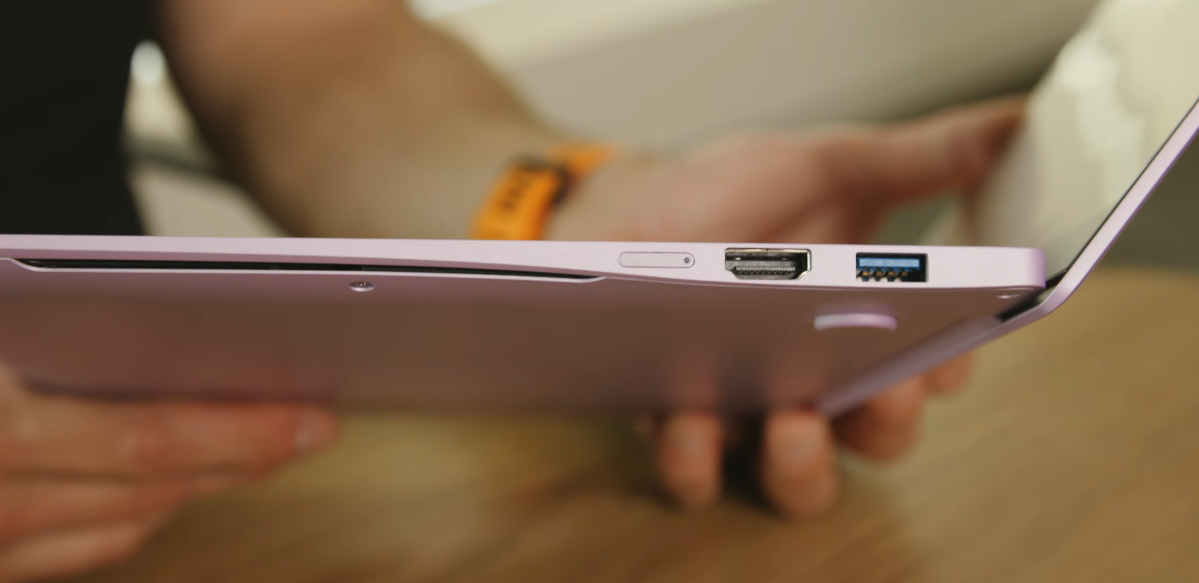
On Intel’s video, Gao showed off a pair of Intel’s Firefly reference designs, both in a lilac color with “Intel Color” attached. One was just 12.9mm thin, all metal, with a variety of ports. Intel removed the bottom ventilation grille (which most laptops include) to give it a “clean” aesthetic, Gao explained. He then wiggled the chassis, showing that these weren’t typical budget laptops that felt cheap, despite shipping at a lower price.
Intel
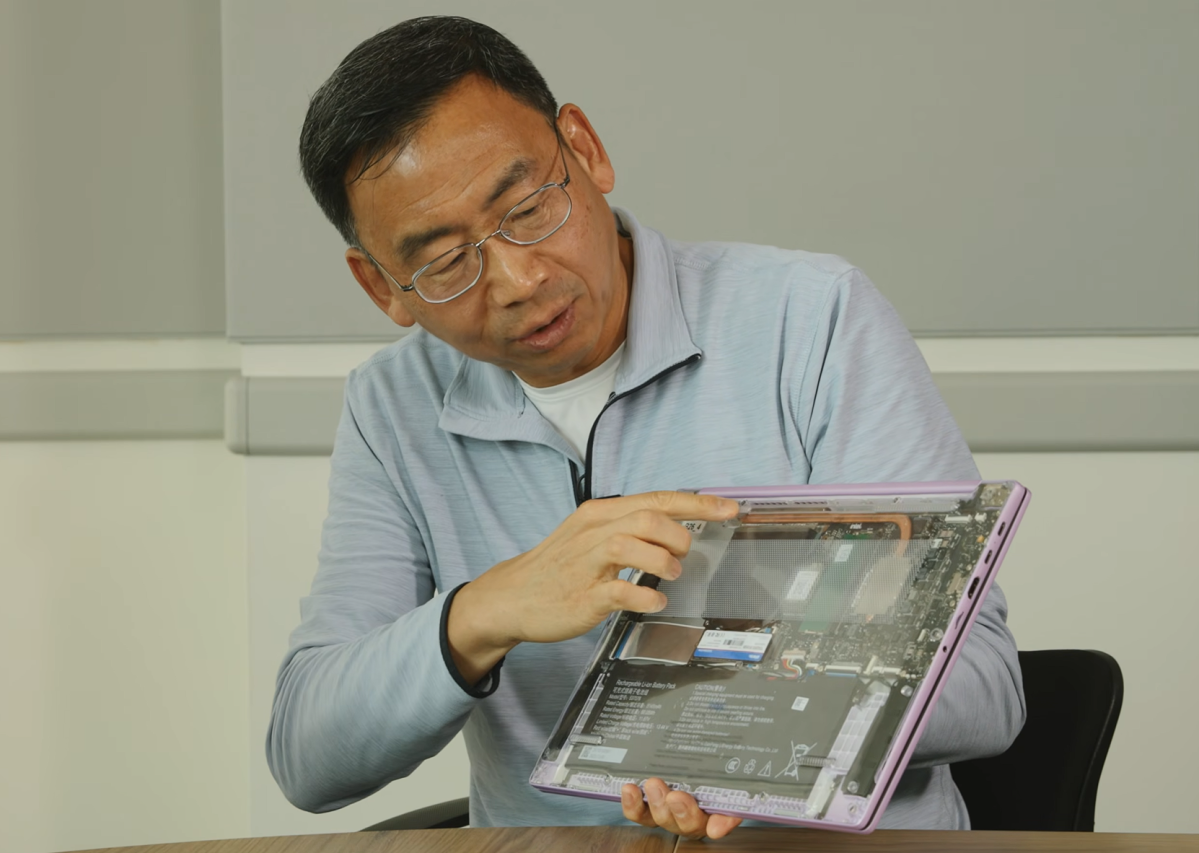
Inside, the reference design Gao showed off used copper heat piping (which can be found in some gaming laptops) to engineer a better cooling solution that cost less. Intel also used a more standardized cabling system to help lower cost. Firefly laptops can also integrate optimized encoder / decoders (codecs) used by smartphones for PCs.
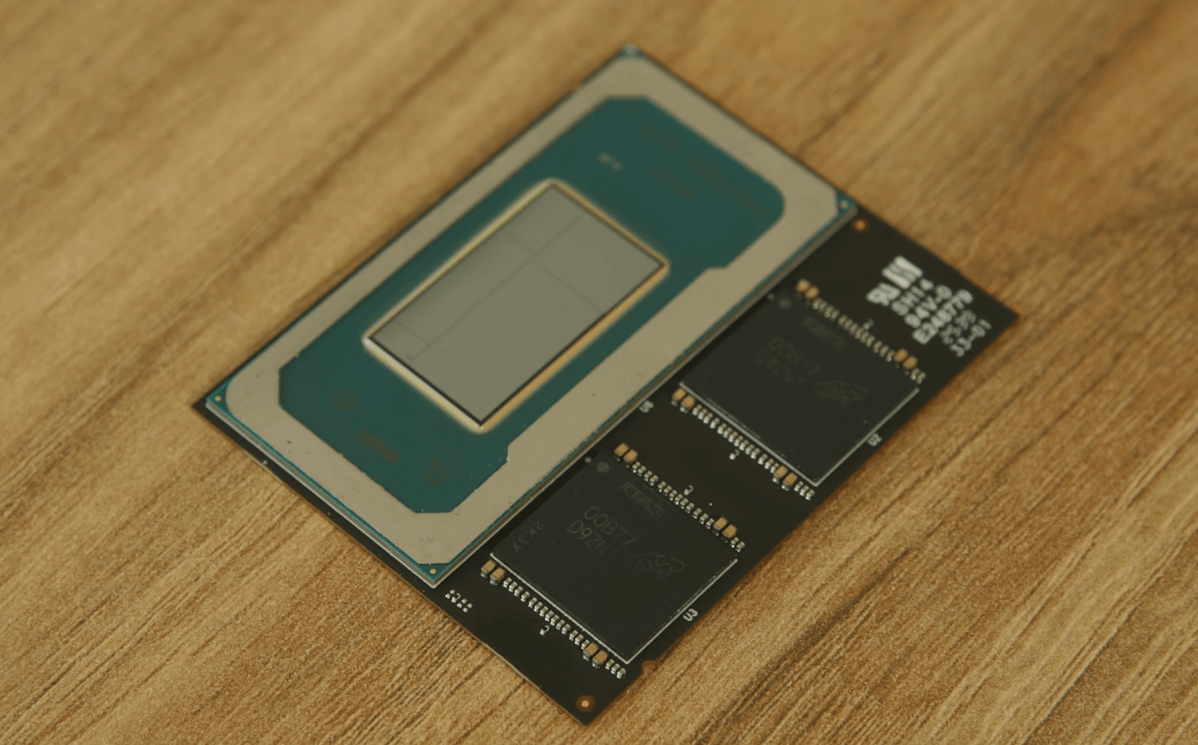
Perhaps the nerdiest, but most interesting change is that Intel is now considering the use of memory traditionally designed for phones to help solve the problem of rising memory prices. Intel’s Gao showed off what he called a “core logic module,” which included phone memory instead. (The demo module Gao showed was based on Panther Lake, not Wildcat Lake.)
Intel
“Even before the memory storage had gone through the roof, our engineers already forecast that if we bring in memory technology solutions, memory from the phone sector to the PC, right, [it’s a] lot more work for Intel,” Gao said. “If we finish it, you know, we define the signal, we define some kind of interposer, you do this whole thing for the entire ecosystem.”
What Intel is trying to do, Gao explained, is the engineering work inside the core logic to accommodate a broader range of codecs and memory, offering laptop makers more choice in a bid to lower the overall price of the end laptop.
Gao said that Dell, HP, Lenovo, Acer, Asus, and other partners would be shipping Wildcat Lake-based Firefly designs in the future. “Some of them already hit the market, and I heard that some of them sold out already,” Gao said, without any further elaboration.
Presumably some of those have occurred only in China, because the laptop partners I queried about Firefly didn’t mention the initiative, and at least one unannounced Wildcat Lake laptop I’ve held included underside venting, and appeared to be made of plastic as well.
Still, inexpensive laptops are getting sexy again, whoever makes them. Could Intel’s Project Firefly evolve into a laptop badge signaling a quality laptop at a reasonable price? Let’s hope so. I’m not sure I can handle another generation of uninventive laptops at stratospheric prices.