

Summary created by Smart Answers AI
In summary:
- PCWorld reports that Nvidia’s RTX Spark chip combines a 20-core Grace CPU with Blackwell RTX GPU, potentially revolutionizing gaming handhelds by 2027.
- The chip supports DLSS 4.5 upscaling technology, which surveys show delivers superior performance and visual quality compared to AMD’s FSR used in current handhelds.
- RTX Spark could enable 60+ FPS gaming on demanding AAA titles, though pricing and battery life remain unknown concerns for future handheld integration.
Nvidia made a big splash at Computex this week by announcing RTX Spark, a new slice of silicon shipping in laptops this fall. RTX Spark unites an Nvidia CPU and GPU in a single System-on-Chip with up to 128GB of memory.
Nvidia’s pitch centers RTX Spark around agentic AI, but I’d argue an equally exciting opportunity places the silicon in gaming handhelds.
As one might expect, company chief Jensen Huang pitched these new RTX Spark chips as harbingers of the personal AI agent era, a fabulous imagined future in which you simply ask your Spark-powered Windows ultraportable to do things for you, and the personal AI agents onboard will hop to it. It’s an appropriate vision given that Nvidia’s rise to world’s most valuable company has been driven by the company’s big pivot into AI hardware and software.
Still, after testing a slew of “AI laptops” and AI agents over the last few years, I’m awfully dubious about trusting these evolving technologies with anything more complicated than generating images for a laugh.
For me, what makes this the most exciting announcement of Computex 2026 is the potential for new RTX Spark chips to give PC gaming handhelds (and thin-and-light laptops) a big performance boost. The RTX Spark chips pair a 20-core Nvidia Grace CPU with an Nvidia Blackwell RTX GPU sporting 6,144 CUDA cores, which is exactly how many cores you’ll find in an Nvidia GeForce RTX 5070 desktop GPU.
Beyond that, the two powerhouses are linked via Nvidia’s proprietary NVLINK technology, which is capable of delivering more data faster than more traditional PCI Express connections.
That doesn’t mean you should expect the same performance from a 14-inch, Spark-powered ultraportable as you can from your desktop gaming PC packing an RTX 5070. However, it does mean that RTX Spark laptops and mini PCs may deliver significantly better gaming performance than competitors packing SoCs from the likes of AMD, Apple and Qualcomm.
Notably, RTX Spark is the first laptop SoC that will support Nvidia’s DLSS 4.5 upscaling tech, which means new Spark-driven systems should be able to take full advantage of framerate-boosting features like Multi-Frame Generation.
All the DLSS performance upgrades with none of the AI slop

PC gaming handhelds like the ROG Ally devices (pictured) are already pretty great, but none support DLSS 4.5 — which could give RTX Spark handhelds a leg up performance-wise.
Michael Crider/Foundry
Not everyone is in love with Nvidia’s AI-driven DLSS upscaling tech, especially since the company recently turned a lot of people off by introducing DLSS 5 with a new feature that uses generative AI to dynamically improve image quality. While CEO Jensen Huang said DLSS 5 will represent a “GPT moment for graphics” by “blending hand-crafted rendering with generative AI to deliver a dramatic leap in visual realism” when it debuts this fall, early tech demos sparked backlash because the generative AI additions made real-time gameplay look like, well, AI slop.
But RTX Spark only supports DLSS 4.5, which means you should be able to enjoy all of the performance-enhancing features (including Dynamic Multi-Frame Generation, Super Resolution, and Ray Reconstruction) without the yassifying effect of DLSS 5. And while that’s great news for anyone who dreams of playing Cyberpunk 2077 at a decent framerate on their thin-and-light laptop during a long flight, I think it’s even more exciting for the future of PC gaming handhelds.
This is a big deal because right now no gaming handheld natively supports DLSS except the Nintendo Switch 2, which is powered by a custom-built Nvidia Tegra SoC. And while the Switch 2’s popularity is undeniable, it’s not really in the same league as modern handheld gaming PCs, nearly all of which — from the Asus ROG Ally X to the Lenovo Legion Go to the Steam Deck — are powered by an AMD Ryzen SoC. While those chips support AMD’s FSR upscaling tech, in my anecdotal experience I’ve typically found FSR to deliver less impressive performance upgrades than Nvidia’s DLSS 4.5 technologies.
A quick trip across the web suggests I’m not the only one with this opinion. If Reddit threads and forum posts aren’t enough, the German PC fan site ComputerBase recently surveyed thousands of readers to determine whether they preferred the look of six games running natively vs. upscaled via Nvidia DLSS 4.5 or via AMD’s FSR 4 tech. DLSS 4.5 was the winner across all six games, with many viewers preferring the look of the DLSS 4.5 version over native gameplay.
I’ve been covering Nvidia’s upscaling tech since DLSS debuted on the RTX 20-series cards back in 2018, and I can confidently say it’s gotten an awful lot better in the last few years.
I’ve been covering Nvidia’s upscaling tech since DLSS debuted on the RTX 20-series cards back in 2018, and I can confidently say it’s gotten an awful lot better in the last few years. In the early days, turning on DLSS often caused odd graphical artifacting and weird framerate issues in games (if they supported DLSS at all), but in the last year or two it’s gotten good enough that I have no compunction about flipping on DLSS if a game is running slower than I’d like.
And while I was initially skeptical of DLSS 4.5’s Multi-Frame Generation (which taps AI algorithms to dynamically generate up to 6x additional frames that are then inserted between “real” frames of gameplay to boost framerate), after testing the latest version in games like Alan Wake 2 and Cyberpunk 2077, I’m a believer. I don’t necessarily love all the ways AI is being injected into the software and hardware I use, but I do love being able to flip a switch in games to nearly double my framerate without any noticeable decrease in image quality.
If Nvidia can deliver that kind of performance improvement in games running on RTX Spark systems, I think PC gaming on the go is about to get a real shot in the arm. And while Nvidia has only confirmed that RTX Spark chips will be shipping in laptops and mini PCs by the end of 2026, I have to assume that we’ll also see these performance-focused SoCs showing up in handheld gaming PCs down the line.
If that proves true, we may be looking at a 2027 in which playing 007 First Light or Cyberpunk 2077 on a handheld at 60+ frames per second with high-end graphics is not only possible but commonplace—and that’s a future I’d like to see.
But RTX Spark questions remain
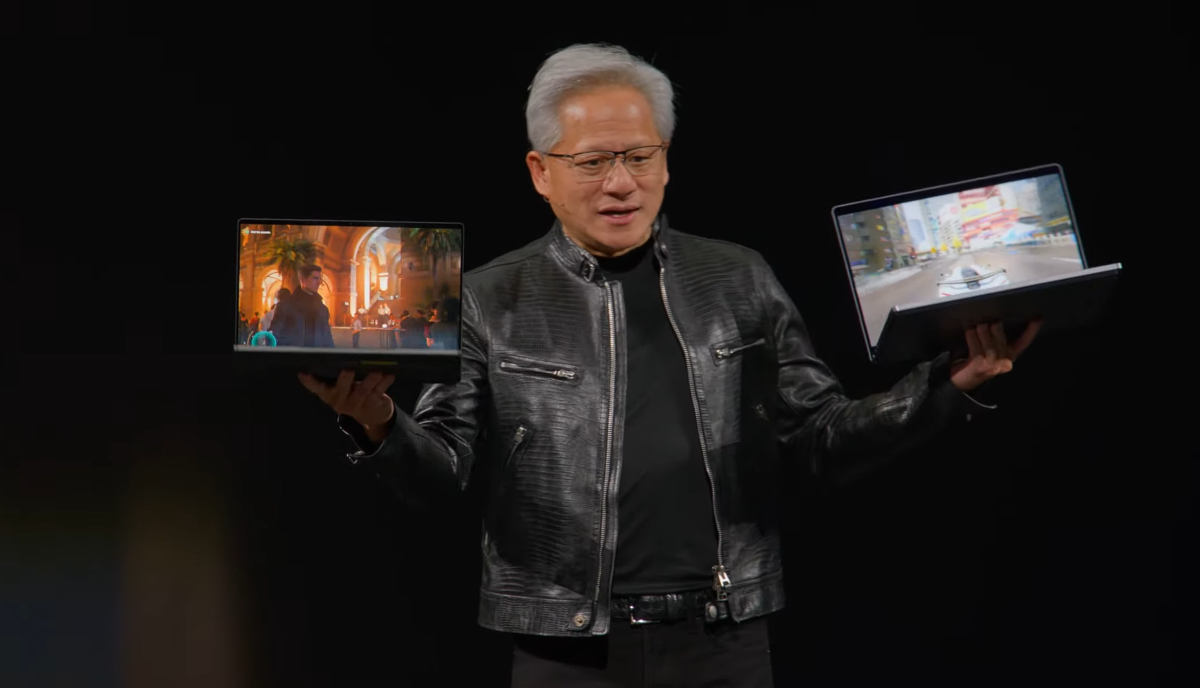
We don’t yet know how much RTX Spark systems will cost or what kind of battery life they’ll offer while gaming, but I wouldn’t count on them being either cheap or long-lasting out of the gate.
Nvidia
There are some caveats to consider as Nvidia tries to muscle in on the SoC market that Apple, AMD and Qualcomm currently dominate. Notably, we have no clue how much these RTX Spark chips will cost, or what kind of power they’ll draw, especially under the heavy load that is high-end PC gaming.
While Nvidia doesn’t really need money right now, I have a hard time imagining the company would sell these chips at a loss, and with memory and storage currently costing a king’s ransom, I doubt a high-end RTX Spark system kitted out with 64-128GB of RAM is going to be cheap.
For context, Nvidia sells its recently announced DGX Spark mini PC (which sports 128GB of RAM and is powered by a GB10 Grace Blackwell chip that’s structurally very similar to the RTX Spark SoC) for a cool $4,699. So, if you’re thinking of buying a new RTX Spark mini PC when they debut later this year, I would expect to spend at least about as much as you would on a new Mac Studio—and I could easily see high-end Spark laptops costing as much as a good MacBook Pro.
Even if Nvidia can manage to sell smaller, weaker RTX Spark-powered handheld PCs at a competitive price (which could still be eye-watering given that even the cost of an entry-level Steam Deck just went up $300), the question remains how hot they’ll get and how long they’ll last if you’re using them to play high-end PC games. While Nvidia promises RTX Spark laptops will be able to play “AAA games at 1440p resolution and over 100 frames per second” with ray tracing and all the other bells and whistles we expect from Nvidia RTX GPUs, the company has said nothing about how much wattage these chips draw or what sorts of battery life we might expect when they’re running at full power.
So, while I think the most exciting aspect of these new RTX Spark chips is their gaming potential rather than their support for a dubious future of agentic AI in Windows, we have to wait and see how these systems perform in real-world testing before we get too excited. But if Nvidia and its hardware partners can manage to deliver thin-and-light laptops, power-sipping mini PCs, and lightweight gaming handhelds powered by RTX Spark and with robust battery life and (fairly) affordable prices, this could be a game-changer for PC gaming—and a shot across the bow of Apple, AMD, and Qualcomm.