

Home backup battery solutions don’t need to be huge, heavy, and ultra-powerful. The Anker SOLIX S2000 is smaller than its competitors, yet it provides enough power to keep your essentials running for days. It’s also super efficient, so you won’t be wasting a bunch of energy just to keep it running. Just keep in mind it is optimized for home backup use. This is why it has very few USB ports, but it makes up for that in AC port availability.
We all think of adventure when looking at portable power stations. I automatically imagine the great times I can have camping, or rolling around the country in an RV. As fun as these can be, though, I most appreciate them at home, during power outages. That’s when electricity stops being a luxury, and it becomes a necessity.
The Anker SOLIX S2000 is designed specifically for this purpose. It is meant to work as a backup for essentials like a fridge, a router, or, even more importantly, medical devices like a CPAP machine. Of course, it’s not limited to those uses, but it is optimized for them. Should you get one? Let’s get into the nitty-gritty and tell you all about my experience after a week pushing it to its limits.
Design and build quality

Edgar Cervantes / Android Authority
In my experience, power stations of this size and weight are usually made with some mobility in mind. They are meant to be carried, whether it’s to and from the car, or around a campground. This one isn’t that type of power station. It is mainly designed to stay put at home, and you can tell.
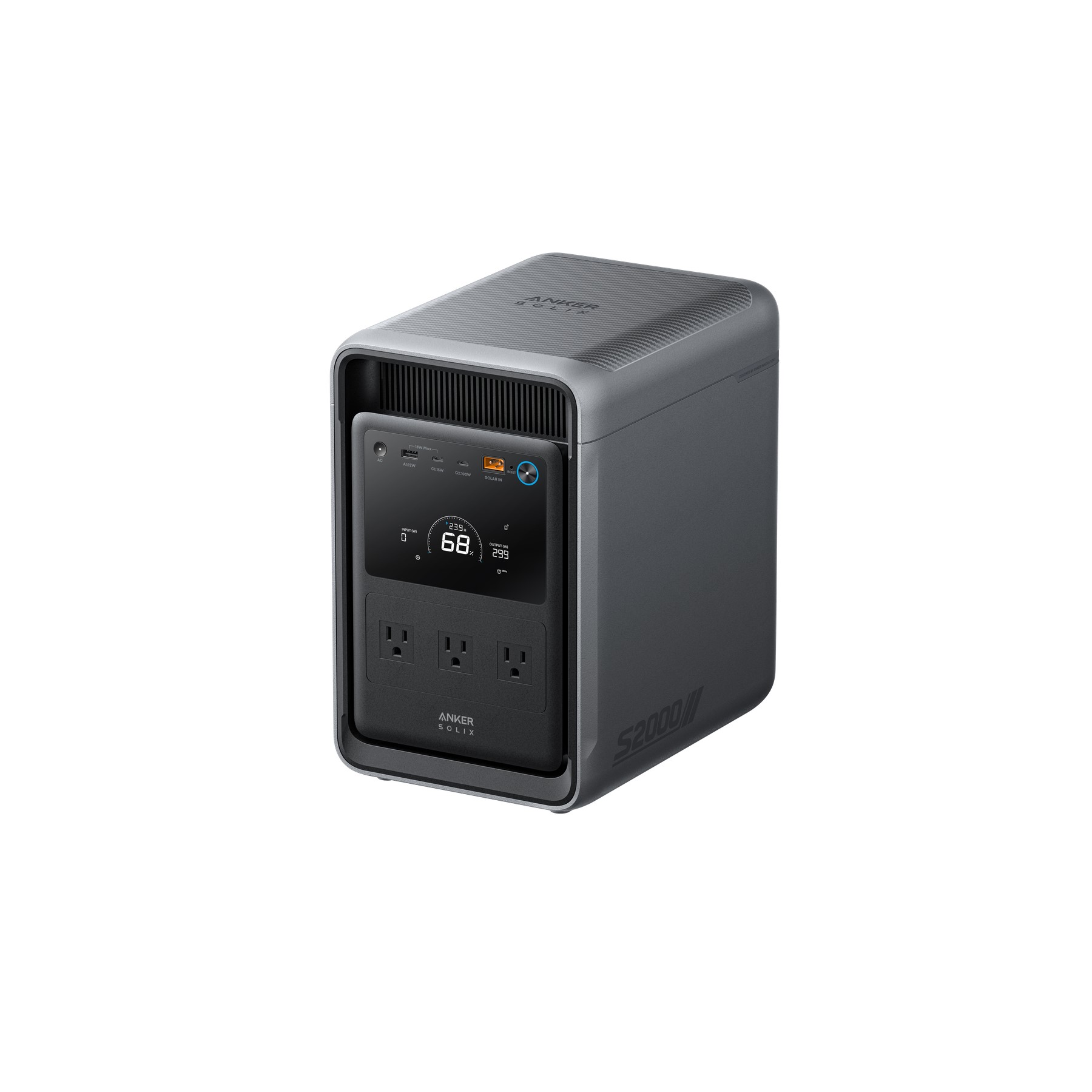
Weighing in at 35.7 lbs and measuring 8.2 × 11.1 × 12.7 in, it is still technically portable enough, and you can easily move it around your home if you’re using both hands. It lacks a handle, though. The indentations on the front and back serve as a kind of double handle, but they don’t offer the same handling confidence as those in power stations designed for mobility. It is also closer to being a square, which makes carrying it a bit inconvenient. That said, the shape makes it work great for its intended purpose. I feel like it fits a regular kitchen or room more naturally.
The Anker SOLIX S2000 is tiny for a 2,010Wh battery.
Actually, the size and weight are major highlights here. My first thought when looking at this was: “Wow, this is tiny for a 2,010Wh battery.” And I actually have a direct competitor at home. The DJI Power 2000 has a very similar battery capacity, and it is significantly larger and heavier! Actually, Anker claims the S2000 is the “smallest and lightest 2kWh power station” around. I know I haven’t seen a more compact one, so I would believe it.

Edgar Cervantes / Android Authority
Of course, you’re also getting Anker’s build quality here. The unit blends into any decor and feels very sturdy, even though it’s mostly plastic. There is such a thing as high-quality plastic, and I believe this one has it (like most other Anker products).
I’ll talk more about this in the ports section, but another design element I like is that two of the AC ports are located in the back. That’s a nice touch if you want to hide some of the cables away, especially if you’ll be using them permanently. For example, you could leave the fridge plugged into the back of the power station; that way, it stays hidden, and the power station looks less cluttered.
Ports: AC takes the spotlight!

Edgar Cervantes / Android Authority
You can really see the power station’s focus in the ports. AC outlets dominate, with a total of five. Two are in the back, as mentioned above. These are great for hiding products you will keep plugged in indefinitely, creating a cleaner, more wire-free look. There are also three AC outlets in the front.

Edgar Cervantes / Android Authority
Sadly, you can also see the Anker SOLIX S2000’s priority when you look at the other ports. It only has two USB-C connections and a single USB-A port. One USB-C port can reach 100W. The other USB-C port supports up to 15W, while the USB-A port supports up to 12W. That said, the latter two share a max output of 18W.
The Anker SOLIX S2000 keeps a cleaner, wire-free look with two AC outlets hidden in the back.
I definitely wish there were more USB ports here, but the power station’s selection works if you use it as intended. I power my fridge, kettle, and microwave. It pretty much runs my kitchen during an outage. So far, I have really only used the USB ports for testing. It’s nice to know I could at least use it to charge my phone and laptop in case of an outage.

Edgar Cervantes / Android Authority
There is obviously an AC input to keep the battery juiced. Additionally, there is a DC solar panel input! We’ll talk more about solar charging capabilities in the next section, but it’s nice to know the option is there. This is meant for power outages, after all. The ability to extend the battery life through solar is kind of important.
Small but mighty

Edgar Cervantes / Android Authority
The Anker SOLIX S2000 may look small, but it is actually quite mighty. As already mentioned earlier, it packs a 2,010Wh battery capacity. Anker has also added optimizations to extend battery life as far as possible. It only uses 6W to keep the AC outlets running and ready. And if you turn off the AC outlets, it drops to a mere 2W to keep the battery on. Apparently, this is the industry’s lowest idle power consumption for a power station.
How does that translate to battery life? Well, I was quite impressed. My first course of action was to charge it to 100%. After that, I plugged in my fridge, kettle, and microwave to it. I then simulated an outage by simply unplugging it at 6:55 PM on May 25th. When I checked it again at 9:30 AM on the 26th, it was at 84%. By 9:18 AM on the 27th, I still had 46% left. I kept using it until the morning of the 28th, when it finally reached 10%.
The Anker SOLIX S2000 can run my kitchen on battery for over 60 hours. And that’s without efforts to conserve battery.
This means the battery can run my whole kitchen for a bit over 60 hours, which surpasses any outage I have experienced. Not only that, I wasn’t conservative either. My fridge is small and uses about 50-60W when actively cooling; fridges don’t really run constantly, and only cool for short periods as needed. It’s not a power-hungry appliance, but the others are. I used the kettle three times. Each time, it drained the battery about 6%, which makes sense because it uses over 1,000W. The microwave does, too, and I used that once.
Needless to say, there was no outage, so I really had no urgency to conserve energy. I am sure I could have gone for another full day if I had actually tried to conserve battery power. Your mileage will definitely vary, but I was quite surprised by how efficient this battery is.
It’s also quite powerful and apparently can run 99% of home appliances. With a 1,500W output and support for 3,000W peaks, there is very little this little guy can’t run. My most power-hungry products run at about 1,300W max, so it can literally power everything I own, as long as I am not running them simultaneously.
Also important to note is that, in the event of an outage, the Anker SOLIX S2000 supports 10ms UPS. It will switch to battery mode nearly instantly, and your appliances will run without interruption.

Edgar Cervantes / Android Authority
I drained the battery to 10% during my first simulated outage, so I had to recharge it right after. If you’re in a rush, Anker has UltraFast Charging mode, which you have to enable in the app. It can reach a whopping 1,600W and can recharge the battery completely in under two hours (about 1.7 for me, from 10% to 100%).
While UltraFast Charging is super convenient if you’re in a rush, more wattage means more produced heat, and in the case of power stations, this also translates to noisy fans. Yes, the product got uncomfortably loud. That said, the noise is acceptable at regular loads, and it charges at 1,150W when UltraFast Charging mode is off.
You can also charge it using a 400W solar panel, which promises an 80% charge in just 4.5 hours. Of course, this is under ideal conditions and bright, direct sunlight. The same DC port can also be used to charge the power station at 120W with a car socket, or at 400W with a car alternator charger.
Capabilities are but a fraction of what makes a good power station. I find the lack of energy management an annoying part of most power stations and their apps. To my surprise, the hands-off approach that the Anker SOLIX S2000 can achieve is very nice.
For starters, I like that you can set the recharging input to your preference, and as low as 100W. This helps with two things. For starters, it reduces heat, which helps with battery longevity. This one is rated for 10,000 cycles (this is a LiFePO4 (LFP) battery), which is impressive, and if you’re going to use it long term, you want to increase your chances of keeping it healthy as long as possible. Because of the reduced heat, the fans won’t run as loudly. If you want to keep things quiet, there is also Silent Mode in the settings, and you can schedule it.
Another thing that keeps batteries healthier is not charging to 100% every time. In the SOC Settings, you can set how much you want the battery to charge and how much you want it to discharge. I have it set to stop discharging at 5%, and to charge up to 80%.
My favorite addition was definitely the Power Usage Scenario options. There is Standard Mode, which just charges the battery and keeps it ready regardless of anything. Things can get pretty interesting if you try the other modes, though, and some could literally help you save money.
The Anker SOLIX S200 can save you money in peak electricity costs and spoiled food waste, essentially paying for itself over time.
I live in California, where the sun is shiny and the cost of living is unbearable. Peak electricity pricing is among the most expensive in the country. Time of Use Mode can help save you some cash. You can set your peak and off-peak times, and the battery will only charge during off-peak or mid-peak hours. It will then use stored battery power to run your electronics during peak hours, drawing no electricity from the grid. This means that the Anker SOLIX S2000 could eventually pay for itself in electricity savings!. Peak electricity prices are about 60% higher where I live, so the difference is significant.
I find that even that charging daily may be overkill for my needs, so I have opted for Custom Mode, which essentially lets you set charging schedules. I have it charging every other day, only during off-peak hours. There’s also Self-Consumption Mode, which tracks loads in real time and maximizes solar energy utilization.
There’s also a really cool feature that may come in handy when you need power the most. Storm Guard monitors weather warnings and ensures your battery is charged and ready in case of grid failure.
Anker SOLIX S2000 review verdict: Should you buy it?

Edgar Cervantes / Android Authority
My only real complaints are that the Anker SOLIX S2000 power station has few USB ports, and that the unit doesn’t come with an easy-to-use handle. That said, the smaller dual handles are enough for moving around the house, and the USB ports aren’t really something I am missing much, as I mostly use this to power regular electronics that plug into AC ports, which is the intended use case anyway.
All things considered, this is mainly a stay-at-home portable power station, designed for those who want to keep essential electronics powered through outages. This is why the advertising focuses so much on showing it powering things like fridges, routers, or CPAP machines. It excels for those use cases, less so for keeping smaller gadgets charged.
Its 2kWh capacity is more than enough to get you through most outages, and the low idle power consumption is a breath of fresh air. I’ve seen much larger and capable batteries lose like 10% a day just for being on (not powering anything).
While usually a luxury for fun outdoor adventures, a power station becomes a necessity when most needed. The Anker SOLIX S2000 shines when you most need power.
Overall, this is looking like quite the winner for the right user, and I have enjoyed using it. Its $1,199.99 MSRP is by no means cheap, but it is actually cheaper (and better) than the DJI Power 2000 ($1299 at Amazon) at MSRP. If you want something more portable from Anker itself, there is also the Anker SOLIX C2000 Gen 2 ($1499.99 at Amazon).
All that said, by now we’re used to paying way below retail for power stations, as sales are common, and even the SOLIX S2000 has been less than half its retail price at times since launch. At that price, I am more than comfortable recommending getting one of these. Its nice design, reliability, efficiency, and ample AC ports make it a great addition to your emergency backup setup.
MSRP: $1,199.99
Anker SOLIX is launching it S series with the S2000, a 2kWh portable home power solution with exceptionally low idle losses.
Positives
- Powerful for its size
- Smaller than other 2kWh power stations
- 5 AC outlets
- Super efficient and low idle power consumption
- Excellent smart features
Cons
- Only has 3 USB ports
- Small, but not very portable
Thank you for being part of our community. Read our Comment Policy before posting.