

Summary created by Smart Answers AI
In summary:
- PCWorld reports the Steam Deck has returned to market with nearly doubled pricing, featuring only OLED models at $789 for 512GB and $949 for 1TB versions.
- Valve discontinued cheaper LCD models and attributes price increases to rising memory and storage costs driven by AI industry demand affecting consumer hardware.
- This trend extends beyond Steam Deck to other gaming handhelds like Lenovo Legion Go, signaling broader affordability challenges in PC gaming hardware.
The Steam Deck, harbinger of a portable PC gaming revolution, has been out of stock for three months. Now it’s back… at almost double the price of the original model. It’ll cost you $789 USD to get the 512GB OLED version, $949 for the 1TB upgrade. The original LCD model, which debuted at $400, is resigned to the dustbin of history.
Welcome to PC gaming in 2026, where the K-shaped economy has claimed the last remaining affordable option. The 512GB OLED model now costs $1,129 in Canada, 649 pounds in the UK, 779 euro in Europe, $1,199 in Australia, and 3,279 PLN in Poland. The 1TB OLED version costs 1,349 CAD/919 euro/779 pounds/1,429 dollarydoos/3,879 PLN. Ouch.
Remember, all of these are using AMD integrated laptop graphics from the Zen 2 generation, now six years old. I don’t think anyone would disagree with me when I say that nearly a thousand bucks is too much to pay for the performance you get here.
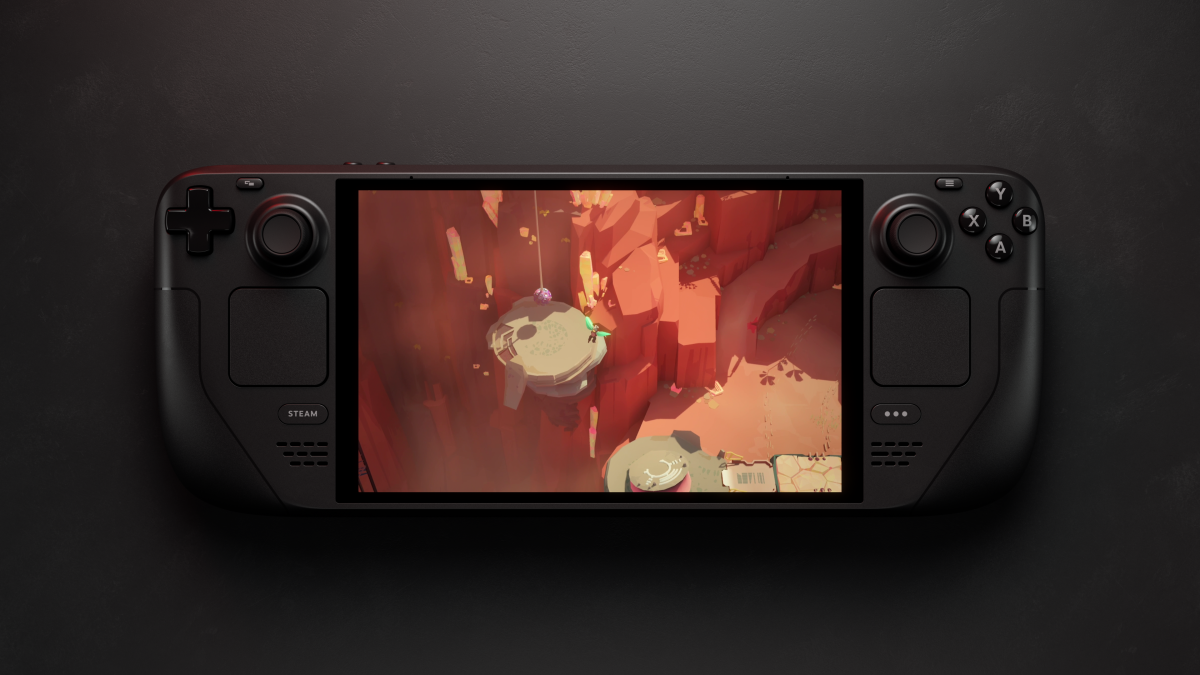
Steam Deck
Valve calls a spade a spade in its announcement post. “Steam Deck is back in stock, with a price increase for both models due to rising memory and storage costs.” We’ve seen similar increases for other hardware like the Lenovo Legion Go series, which now costs almost a thousand US dollars for the “affordable” Go S model that ships with SteamOS instead of Windows.
The rush on RAM and storage as chip producers prioritize profitable “AI” data centers has left both consumers and PC manufacturers with few options but to pay, pay, pay. While memory prices seem to have hit a plateau — at least for now — it’s become essentially impossible to build a desktop PC that can handle the latest AAA games for under $1,000 or so. We’re in a historically strange place where hunting for a discount on a pre-built machine might get you significant savings versus a DIY build, as consumer-packaged RAM has been hit the hardest.
Valve is a huge company, a juggernaut in the gaming space… but it’s not immune to a worldwide rush that has chip producers booked up for months or years. The same RAM crisis has pushed the company’s new hardware projects, the console-style Steam Machine with its discrete GPU and the Meta Quest-style Steam Frame VR headset, to an uncertain “late 2026” timeline. The biggest question from the Steam Machine’s announcement last year is still the most pressing one — how much will it cost? A price under $1,000 seems all but impossible at this point.
We’re starting to see at least a bit of market correction. Memory producers that formerly served the domestic Chinese market exclusively have a chance to go international, as Samsung, SK Hynix, and Micron ignore consumer PCs and other electronics. At least a few Corsair RAM modules are now shipping with memory produced by CXMT, though it looks like those products are still being sold only in China at the moment.
I feel like a broken record here, but once again, the only real hope of relief for RAM and storage prices is if the “AI” bubble pops. And there are signs of that happening, as data center construction starts to meet sharp opposition, from both nearby residents (who object to breathing gas fumes and tripled power bills for the sake of a dozen low-paid jobs) and politicians representing them. But with huge portions of the economy basically holding on to the “AI” bubble for dear life, that scenario would come with its own additional problems.