

Mishaal Rahman / Android Authority
There was a point when everybody knew what Sora was, even if — nay, especially if — they were outside the tech circle. The insanely realistic demo videos drew widespread attention, and OpenAI’s video generation tool went viral overnight, quite literally. It felt like it was having its own ChatGPT moment at the time. Fast forward to today, and Sora is officially dead.
Its demise might lead you to believe that the video generation category itself is having a tough time, but that couldn’t be further from the truth. Our entire social feed is filled with AI-generated slop these days, and Google’s Veo — Sora’s direct competitor — is thriving, as are a dozen other similar tools. So, what did Sora get wrong? And what exactly is Google doing right to stay on top of the video generation game?
Be honest — how do you feel about AI video content?
0 votes
Sora had the hype but not the plan

Ryan Haines / Android Authority
Sora may have caught your attention with its unreal demos early on, but production tools are only as good as the kinds and numbers of creators using them. The latter is more crucial because, given how fast AI cycles move, hype alone can’t sustain a product that isn’t generally accessible. Even in its early days and until recently, Sora’s access was limited to a handful of users. You cannot expect a product to turn short-term virality into sustained success if it relies solely on paid subscriptions in just two countries.
You cannot expect a product to turn short-term virality into sustained success if it exclusively works on a paid subscription in just two countries.
Accessibility is one (quite substantial) part of a video production tool. The second part is just as important: product integration. Video production isn’t a single-tool job, even with the help of the most advanced AI. You need tons of third-party integrations and production options to turn your imagination into reality. Even with its limited user base, OpenAI couldn’t deliver the necessary integrations and tools to Sora as quickly as the industry demands.
When people can’t use your tool the way they want to, they quickly move on to a hundred other alternatives, often never to look back.
Making videos is hard

Megan Ellis / Android Authority
That’s true for both humans and artificial intelligence. For us, it requires every single cell in our body to pour in all its creativity. The cost is similar for AI, too, just in computing.
While image generation is still relatively easy, with billions of static references available, creating a video is a whole different beast. Putting together even a five-second video at 30 frames per second requires creating 150 high-resolution images, all without losing consistency or natural motion physics — two things that are easiest for AI to get wrong.
Video generation requires stitching together hundreds of photos, all without losing consistency or natural motion physics — two things that are easiest for AI to get wrong.
Generating videos requires a lot more compute than just creating 150 individual images, because the model has to remember what just happened and prepare for what’s coming next, then render it all together. That’s a multi-step process spanning every single frame, which leads to higher memory and GPU usage, especially as the resolution increases to 1080p or even 4K. That is the very reason why memory quickly becomes a bottleneck in AI (hence the recent shortage).
Not to forget all the copyright and safety issues, including IP infringement and deepfakes, on top of all that. There was also the heat ChatGPT felt from Claude, pushing it to cut down all distractions — namely, Sora — but that’s a story for another day.
Meanwhile, Google built for volume

As it turns out, the internet rewards quantity over quality, which is why our Twitter, Instagram, and TikTok feeds have recently been flooded with low-quality AI-generated content. And there are tons of AI generation tools in the mainstream like Kling AI, HeyGen, Runway, etc. While Kling AI may be a popular industry choice right now, Google Veo is often ranked among the top options as well. There are multiple reasons for that, like output quality, realism, and native audio generation, but one key metric helped it soar (pun intended): distribution.
Users quickly adopt what they have access to, and Google knows this.
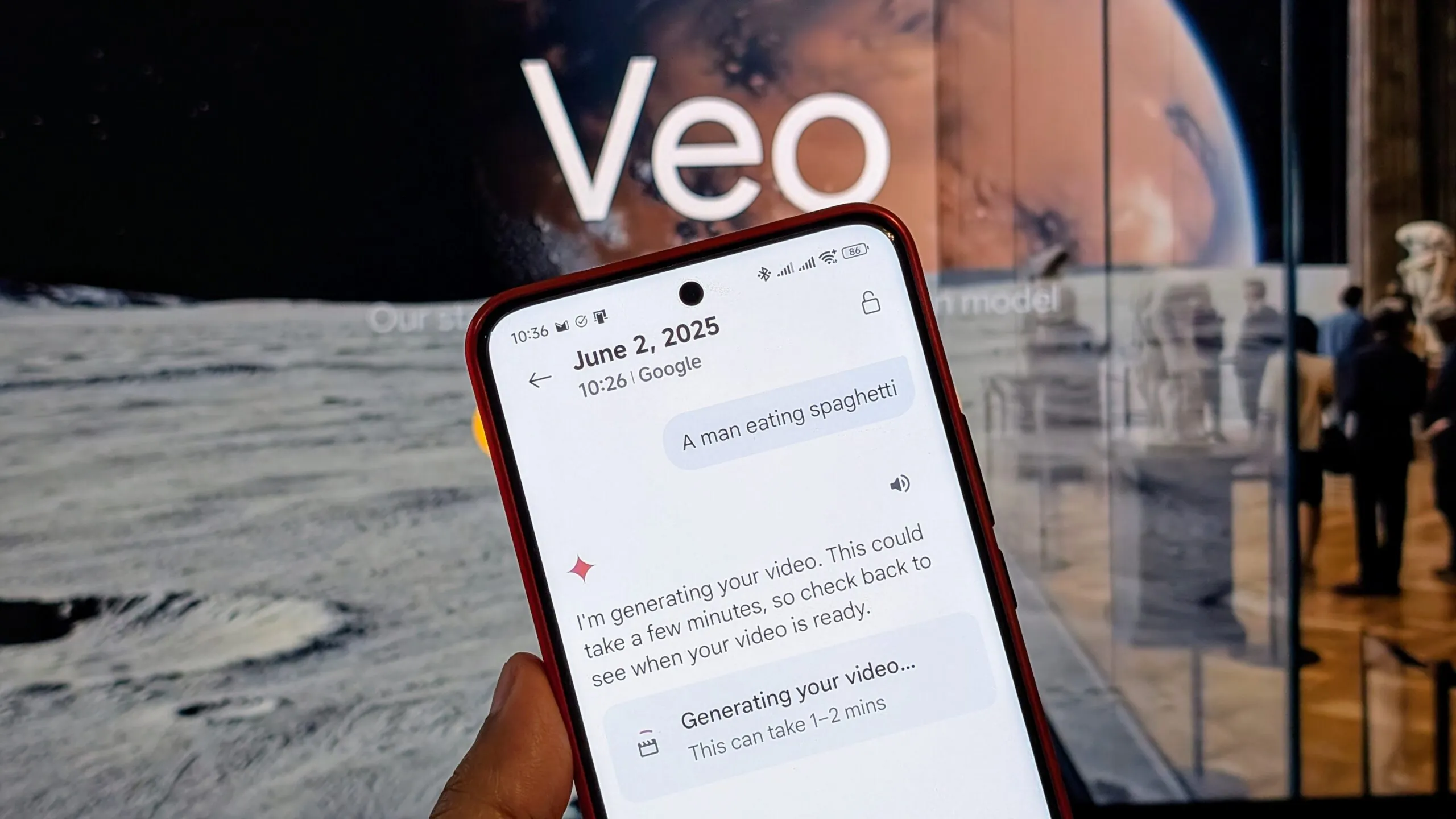
With Sora and every other computing tool, you have to visit a dedicated page or tool to generate a video, but Google doesn’t play by those rules. Riding on Gemini’s widespread availability — literally on every single Android phone by default — Google integrated video generation inside Gemini itself. It simply lets you type the prompt in natural language without having to worry about the model it’s using in the background to create a video — exactly how simple the experience should be for end users.
Users quickly adopt what they have access to, and Google knows this. That is the very reason it recently integrated Veo 3.1 directly into YouTube Shorts, allowing people to create vertical videos on the fly. That’s the kind of scale and integration that Sora simply couldn’t even dream of matching.
Don’t want to miss the best from Android Authority?


You have to think how creators think

Mishaal Rahman / Android Authority
Filmmaking, or any kind of video production, isn’t just about creating moving images. A full-blown production pipeline requires precise control over production and, later on, over editing. While Sora was good at turning your imagination into reality, Google Flow offers a production suite that lets you create a clip scene by scene. That alone saves you a lot of time and effort compared to recreating a video over and over if it doesn’t get it right.
Google Flow better adheres to your prompts and includes a dedicated asset management tool, resulting in a much higher level of character consistency. And it’s not just a video production tool, which requires you to use a third-party tool for audio generation — you can do that natively. And if you lean towards professional video production, there is also a feature called Camera Controls that lets you pick the camera angle and motion. That’s a full-blown production suite in the palm of your hand.
Of course, the usage limits vary depending on the Workspace or Google One AI plan you are on. But the fact is that you can access Google Veo with some usage caps, even on the entry-level Google AI Plus plan, or even for free. That last bit has proven crucial, along with every other box that Google ticked, in making Google’s video production tool more accessible than Sora.
Sora had to die because it never became usable at scale, while Google’s boring old approach to distribution worked wonders.
If you look at the bigger picture, the AI-driven video production market is thriving, and only Sora has had to drop out of the race. While we may be quick to dismiss AI slop as soon as it appears on a screen, it has proven to be a reliable metric here, substantiating that access beats quality.
Sora had to die because it never became usable at scale, while Google’s boring old approach to distribution worked wonders. I bet there’s some lesson here for business management students to take home from Google.
Thank you for being part of our community. Read our Comment Policy before posting.